
B2B fintech web application that Automates Revenue Recognition for businesses using Stripe
In 2025, I had the opportunity to design Calqy—a fintech SaaS platform that automates revenue recognition for Stripe and brings clarity to complex financial operations.
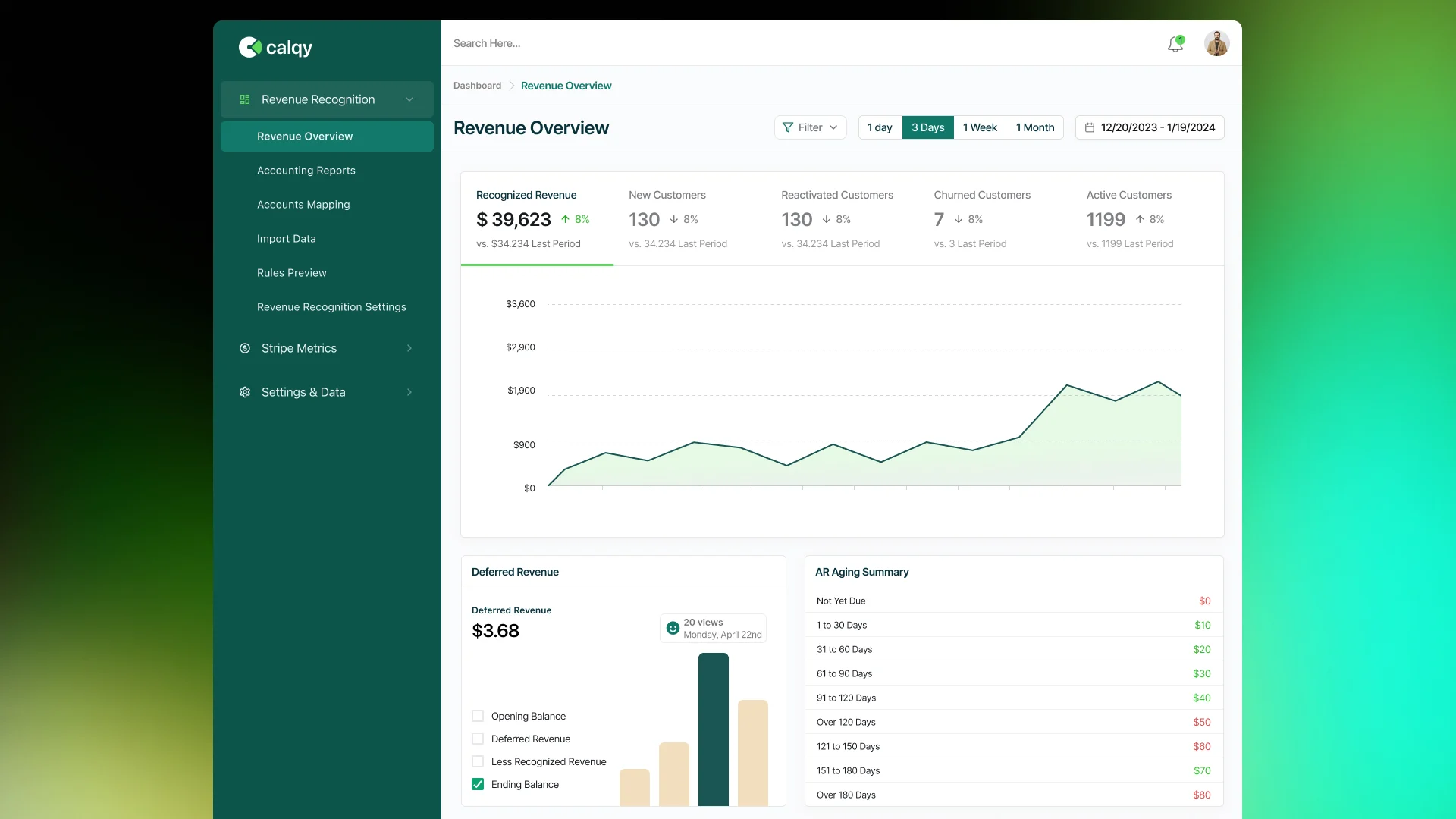
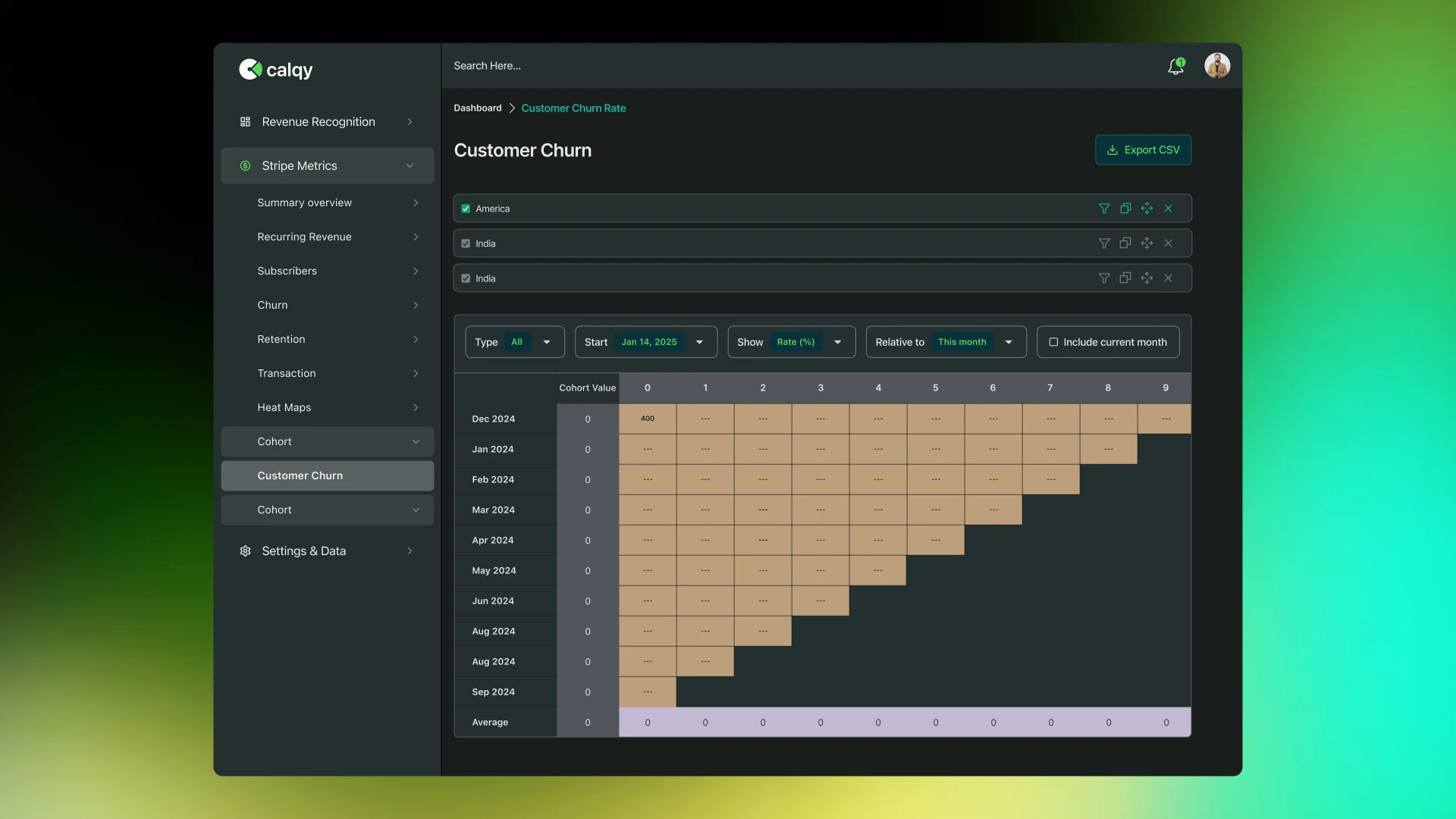
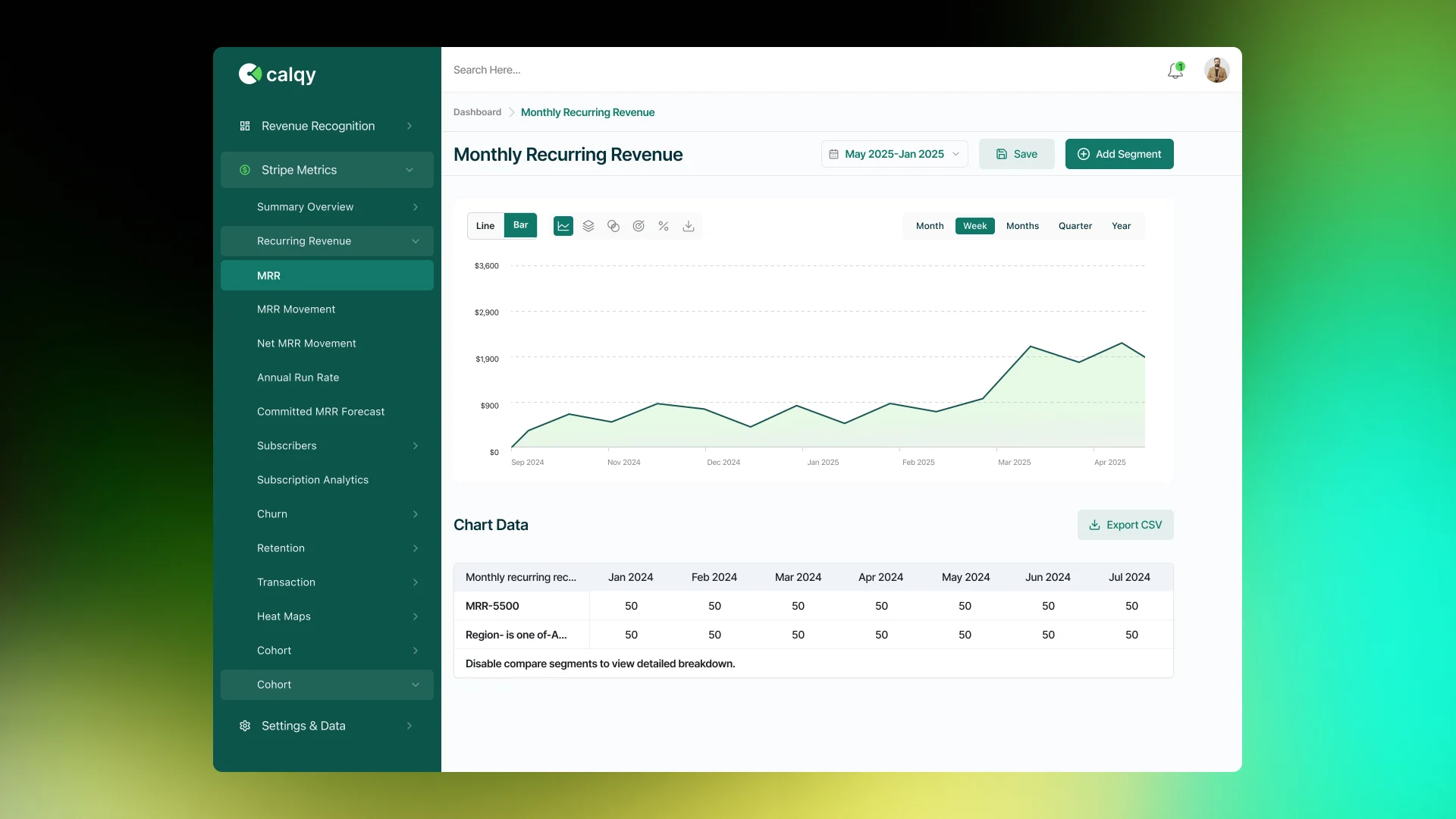
📝 Note: Due to NDA restrictions, I cannot share Figma or HTML/React prototypes directly. However, I’d happily walk you through the product in a live demo via Zoom.
At a Glance
Role: Senior Product Designer
Duration: 2025
Industry: FinTech / Accounting SaaS
Platforms: Web Application + Marketing Website
Responsibilities: Product Strategy, UX Research, Information Architecture, User Flows, Wireframing, UI Design, Design System, Branding, Prototyping
Project Overview
Calqy is a fintech web application designed to help businesses simplify complex accounting operations, revenue recognition, invoicing, refunds, disputes, bad debt management, and financial reporting.
Modern finance teams often rely on multiple spreadsheets and disconnected accounting tools to manage their revenue lifecycle. This creates operational inefficiencies, increases the risk of errors, and makes it difficult to maintain financial transparency.
As the product designer on the project, I owned the end-to-end design process: from market research and competitive analysis through information architecture and user flows to a complete set of low-fidelity wireframes, a polished high-fidelity Figma prototype, a brand identity, a design system, and the public marketing website at calqy.com.
| My Deliverables | Tools Used |
|---|---|
| – Competitive analysis & market research – Mind map (app information architecture) – User flows (complete & edge-case paths) – Low-fidelity wireframes – High-fidelity Figma prototypes – Brand guidelines – Detailed design system – Marketing landing page (calqy.com) | – Figma (design, prototype, design system) – FigJam (mind mapping, flows) – Notion (PRD reference & documentation) – WordPress (landing page) |
The Problem
Finance teams at fast-growing SaaS and subscription businesses face a hidden operational crisis: Stripe tells them what money moved, but not when they can actually count it as revenue.
Fragmented Financial Operations
Accounting workflows are spread across spreadsheets and multiple tools.
Complex Revenue Recognition
Deferred revenue and earned revenue calculations are often manual and error-prone.
Difficult Exception Handling
Refunds, credit notes, disputes, and bad debt scenarios require multiple manual processes.
Lack of Visibility
Finance teams struggle to understand the real-time status of revenue and liabilities.
Compliance Challenges
Financial data must be maintained accurately and consistently for reporting and auditing purposes.
The result is a painful manual process – accounting teams export Stripe data, massage it inside spreadsheets, apply bespoke logic for upgrades, downgrades, prorations, refunds, disputes, bad debt, and multi-currency losses — then pray nothing breaks at month-end close.
Research & Competitive Analysis
Before any design artefact, I led a research sprint to map the competitive landscape and validate the product hypothesis. The goal was to understand where existing tools fell short — and where a focused, Stripe-native product could win.
Understanding the Domain
Before jumping into design, I spent considerable time understanding the accounting ecosystem and how finance teams work.
I studied:
- Revenue recognition models
- Invoice lifecycle
- Deferred revenue accounting
- Credit notes
- Refund management
- Recoverables
- Multi-currency scenarios
- Financial adjustments
Understanding these workflows was critical because fintech products are not only about beautiful interfaces—they must also support complex business logic and regulatory requirements.
Research Process Stakeholder Interviews
We conducted sessions with:
- Founders
- Finance professionals
- Accounting teams
- Operations stakeholders
The goal was to understand:
Competitors Analysed
- Spreadsheet workflows (Excel / Google Sheets) — still the dominant “tool” for SMBs
- Maxio (formerly SaaSOptics + Chargify) — powerful but complex, enterprise-priced
- Chargebee Revenue Recognition — strong billing, weaker on pure rev-rec reporting
- Stripe Revenue Recognition (native) — limited rule customisation, no journal entry export
- Paddle — billing-first, not accounting-first
- Desired reporting capabilities
- Current workflows
- Pain points
- Manual processes
Key Competitive Gaps
| Problem | Competitors | Calqy’s Opportunity |
|---|---|---|
| High setup complexity | Maxio, Chargebee | 3-step onboarding, connect & go |
| Expensive for early-stage | All enterprise tools | Startup-friendly flexible pricing |
| Weak rule customisation | Stripe native | Visual rule builder per scenario |
| No journal entry export | Most tools | QuickBooks sync + CSV export |
| Poor real-time dashboards | Spreadsheets | Live deferred vs. recognised view |
Key Insights ⇣
Users need confidence.
Financial data must always feel trustworthy.
Workflows are complex.
The platform should simplify complexity without hiding important information.
Errors are expensive.
The interface must prevent mistakes and guide users through critical actions.
Visibility is essential.
Users need quick access to financial health and operational status.
SaaS FinTech Metrics I Designed For Calqy
I was designing around core financial and SaaS business metrics, which is particularly valuable for senior product design and fintech leadership roles.
Revenue Metrics
- Monthly Recurring Revenue (MRR)
- Annual Recurring Revenue (ARR)
- Recognized Revenue
- Deferred Revenue
- Unearned Revenue
- Revenue Growth Rate
- Revenue by Customer
- Revenue by Subscription Plan
Invoice Metrics
- Total Invoices Generated
- Invoice Value
- Paid Invoices
- Unpaid Invoices
- Overdue Invoices
- Invoice Collection Rate
- Days Sales Outstanding (DSO)
- Average Invoice Processing Time
Accounts Receivable Metrics
- Total Accounts Receivable (AR)
- Unbilled Accounts Receivable
- Outstanding Receivables
- Aging of Receivables
- Collections Efficiency
Cash Flow Metrics
- Cash Collected
- Pending Cash
- Payment Success Rate
- Payment Failure Rate
- Net Cash Position
Subscription Metrics
- Active Customers
- New Customers
- Customer Lifetime Value (LTV)
- Average Revenue Per Customer (ARPC)
- Expansion Revenue
- Churn Revenue
- Net Revenue Retention (NRR)
- Gross Revenue Retention (GRR)
Refund & Dispute Metrics
- Refund Volume
- Refund Rate
- Dispute Rate
- Chargeback Rate
- Credit Note Volume
- Disputed Revenue
- Recovery Rate
Bad Debt Metrics
- Bad Debt Amount
- Write-off Rate
- Recoverable Amount
- Recovery Percentage
- Uncollectible Revenue
Customer Credit/Tax Metrics
- Customer Balance
- Credit Utilization Rate
- External Credits Issued
- Credit Note Usage
- Tax Liability
- Tax Refund Amount
- Tax Adjustment Volume
Financial Health Metrics
- Gross Profit
- Net Profit
- Operating Margin
- Revenue Leakage
- Financial Accuracy Rate
- Month-over-Month Revenue Growth
Operational Metrics
- Manual Adjustments Count
- Exception Handling Rate
- Reconciliation Completion Rate
- Accounting Error Rate
- Time to Close Books
- Automation Coverage Percentage
Information Architecture
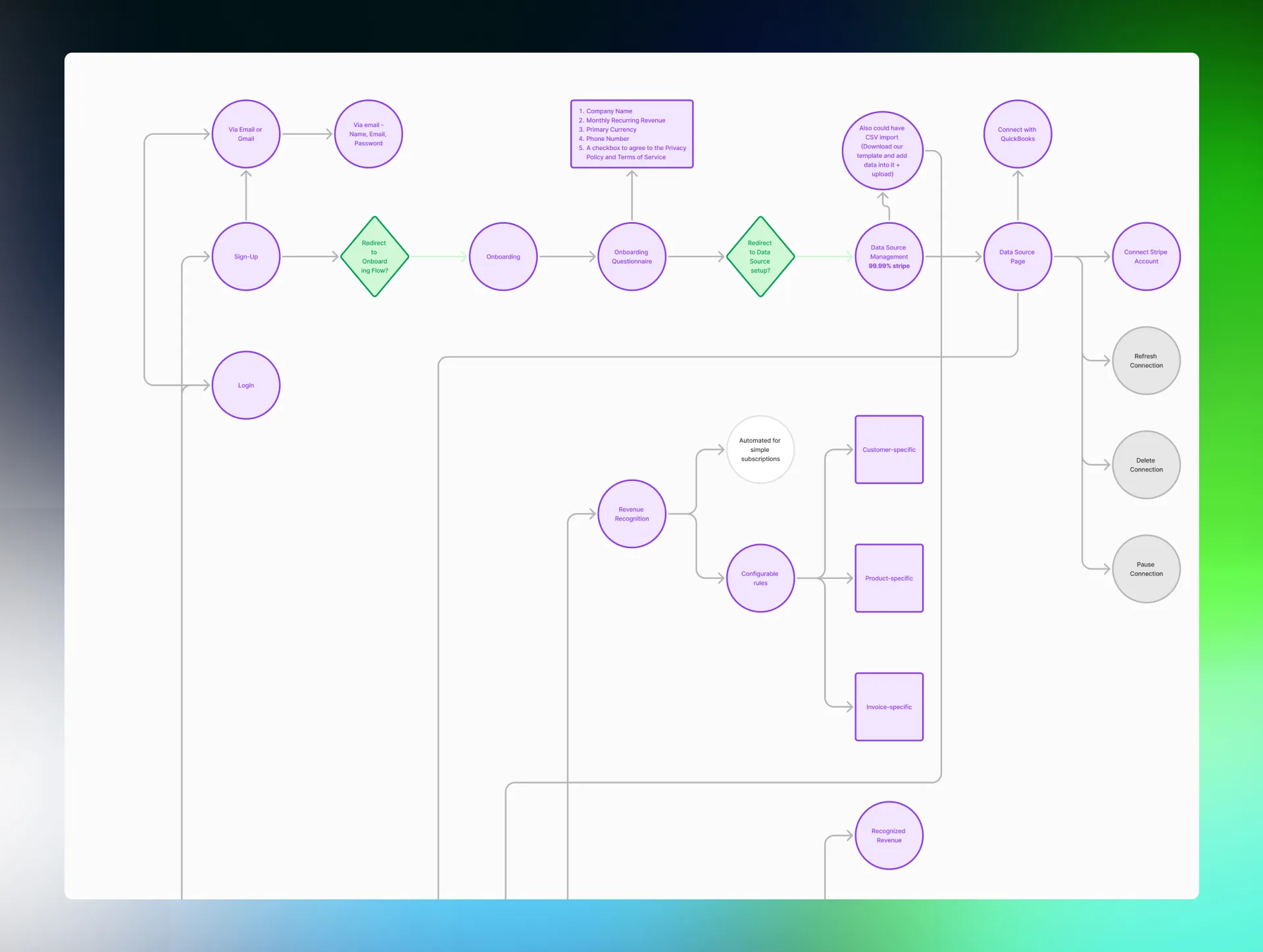
With research findings in hand, I built a comprehensive mind map of the entire application — mapping every major module, sub-section, and decision point. This became the shared source of truth between design and development before a single wireframe was drawn.
Primary App Modules
- Onboarding — Stripe connection, company setup, recognition rule configuration
- Dashboard — real-time KPI summary, recognised vs. deferred split, MRR / ARR overview
- Revenue Ledger — line-item-level breakdown, filterable by period, product, or customer
- Rule Builder — configurable recognition logic for one-time charges, subscriptions, upgrades, prorations, refunds, disputes, voids, and bad debt
- Reports — journal entry view, schedule of revenue, audit-ready exports (QuickBooks / CSV)
- Integrations — Stripe OAuth, QuickBooks sync, multi-entity / multi-currency support
- Settings — team management, permissions, notification preferences, billing
The mind map also captured edge-case branches: multi-Stripe account scenarios, backdated service periods, foreign exchange loss handling, and manual override workflows — ensuring no accounting edge case was left undesigned.
Mind Mapping
I designed complete user flows covering every critical journey through the product. The goal was a “bullet-proof” flow — one where every branch, error state, and empty state was accounted for before a single screen was designed.

Core Flows Designed
Onboarding & Connection
- Sign up / invite team member
- Stripe OAuth connect
- Initial sync & data import
- Recognition rule setup wizard
- First dashboard view
Revenue Recognition Workflow
- Automatic event ingestion from Stripe
- Rule matching per event type
- Deferred → recognised revenue transition
- Manual override flow
- Backdated period adjustment
Reporting & Export
- Generate a journal entry
- Schedule of revenue report
- QuickBooks export flow
- CSV download
- Audit log review
Edge Case Flows
- Refund & credit note handling
- Dispute/chargeback flow
- Bad debt write-off
- Void & unbilled void scenarios
- Multi-currency FX loss
Each flow was annotated with decision points, system states (loading, success, error), and fallback paths. Flows were validated against the PRD accounting scenarios before moving to wireframes.