
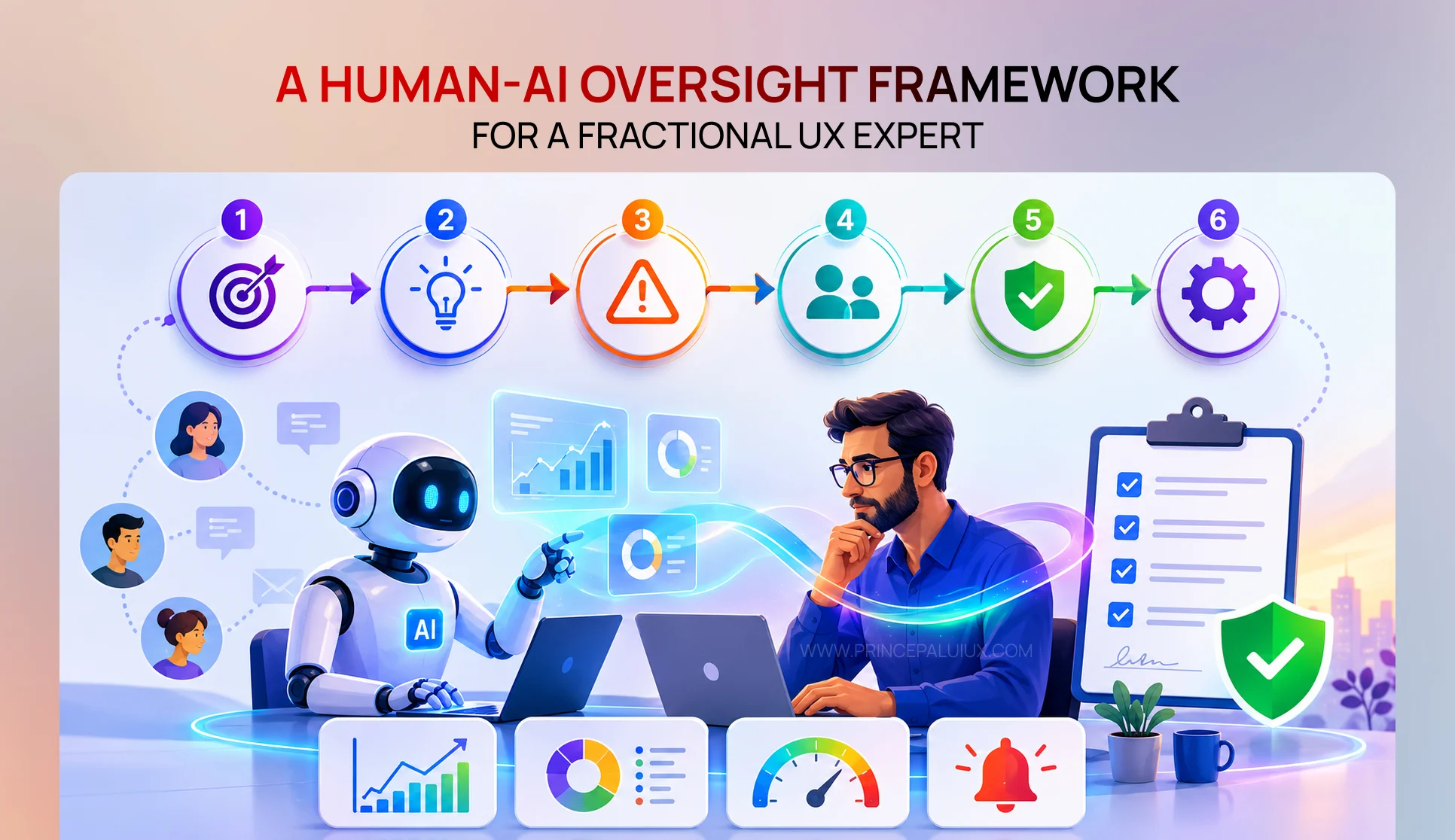
A practical framework for a Fractional UX Expert to design Human-in-the-Loop systems that balance Human-AI Oversight, automation, and human judgment.
Table of contents –
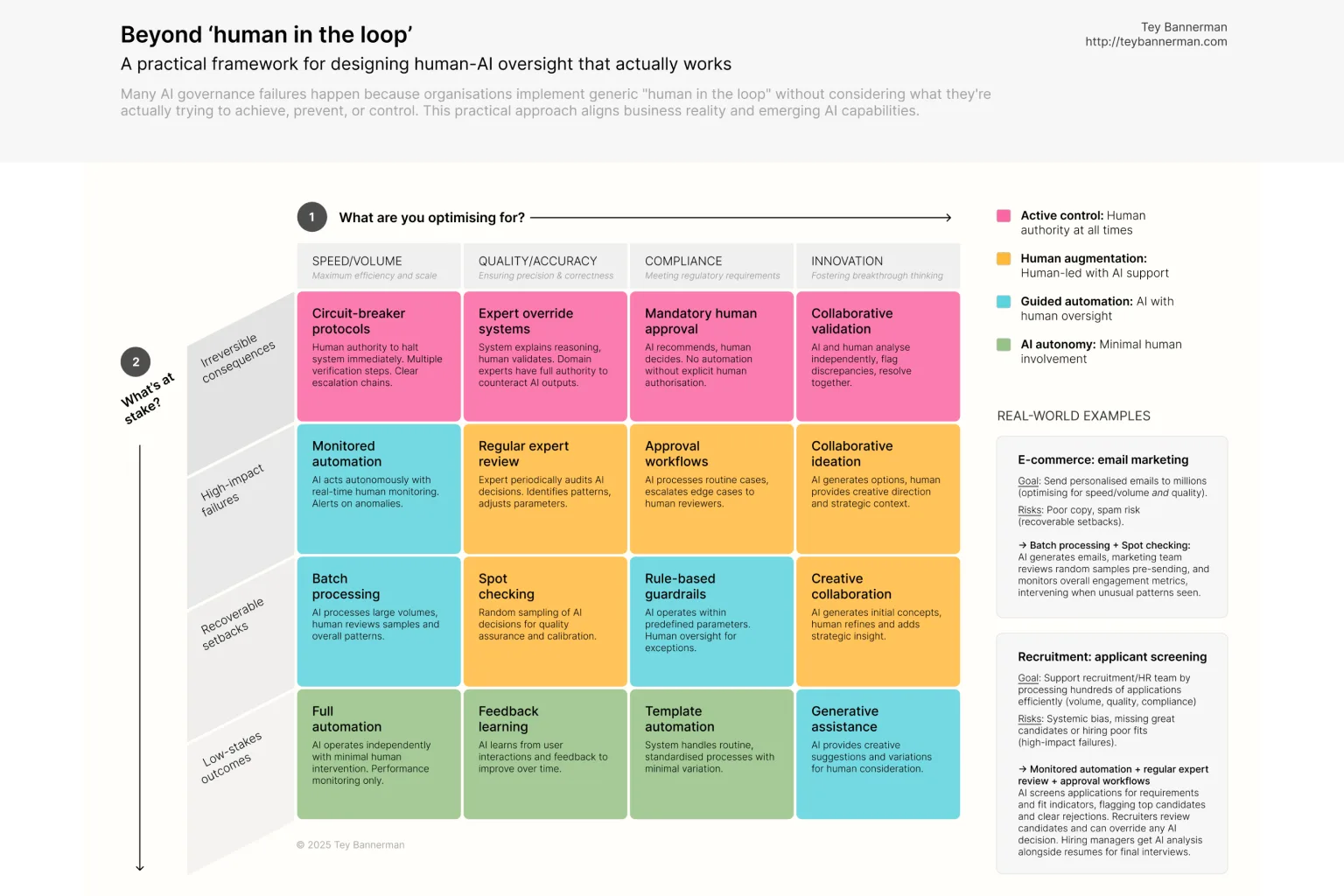
Beyond Human-in-the-Loop: A Practical Framework for Human-AI Oversight That Actually Works
Most AI governance failures don’t happen because the technology is bad—they happen because organisations apply generic “human in the loop” processes without thinking about what they’re trying to achieve, what could go wrong, or where human judgment truly matters.
This framework helps teams design the right balance between people and AI by aligning oversight with business goals, risk, and real-world outcomes.
Artificial intelligence is everywhere in product design right now.
It writes research summaries, generates personas, creates wireframes, reviews interfaces, and even suggests entire product strategies. A fractional UX expert can now support three or four companies at the same time because AI handles work that once consumed entire afternoons.
Sounds amazing, right?
Well, yes and no.
The problem isn’t that AI makes mistakes. Humans do that too. The problem is that many teams still treat AI oversight like a checkbox.
“Let’s put a human in the loop.”
That sentence shows up in meetings all the time. Yet nobody asks an uncomfortable question:
What exactly is the human supposed to do?
Approve everything? Review random samples? Correct edge cases? Stop the system when something looks strange?
Without clear answers, human oversight becomes theatre. People click “Approve” without reading. Teams trust AI too much or not enough. Work slows down, and nobody feels accountable.
For a fractional UX expert, this issue is even bigger. You’re often joining a company part-time. You don’t have the luxury of sitting beside every team member and reviewing every AI-generated output.
You need a framework, a practical one.
Why Generic Human Oversight Usually Breaks
Imagine a restaurant kitchen.
A chef doesn’t inspect every grain of rice. That would be absurd.
Instead, they inspect the ingredients, taste samples, and watch for signs that something is wrong.
AI oversight works the same way.
Many organizations assume humans should review everything. The result?
- Slower decisions
- Frustrated teams
- Rising costs
- False confidence
Ironically, reviewing every AI output can make quality worse because people become numb to repetitive checks.
There’s a name for this: automation complacency.
You’ve probably experienced it yourself. You accept a grammar suggestion without reading it. You trust GPS even when you know the route better.
Humans are funny that way.
The goal isn’t constant supervision.
The goal is meaningful supervision.
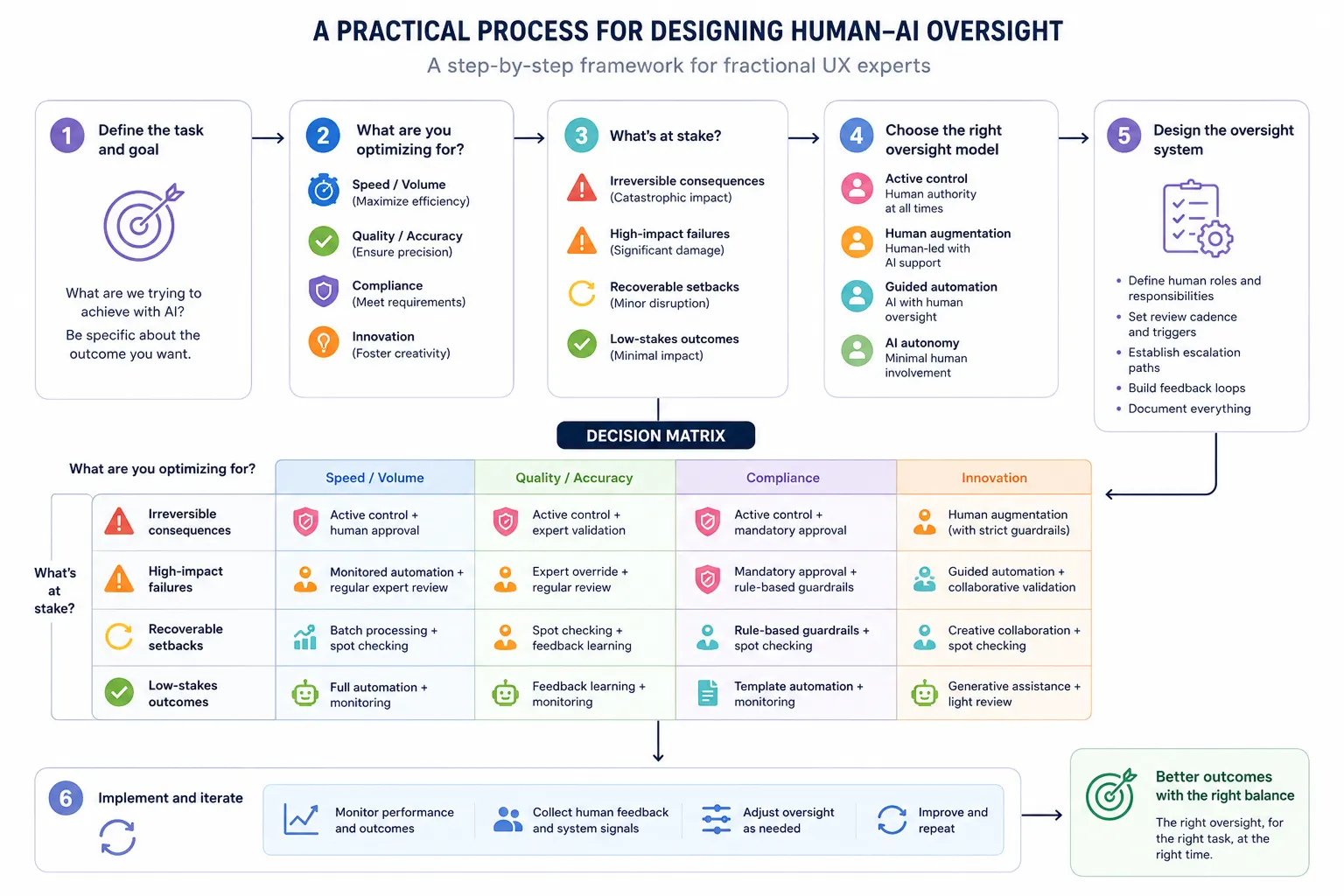
First Question: What Are You Actually Optimizing?
The framework from Tey Bannerman starts with a simple question:
What are you optimizing for?
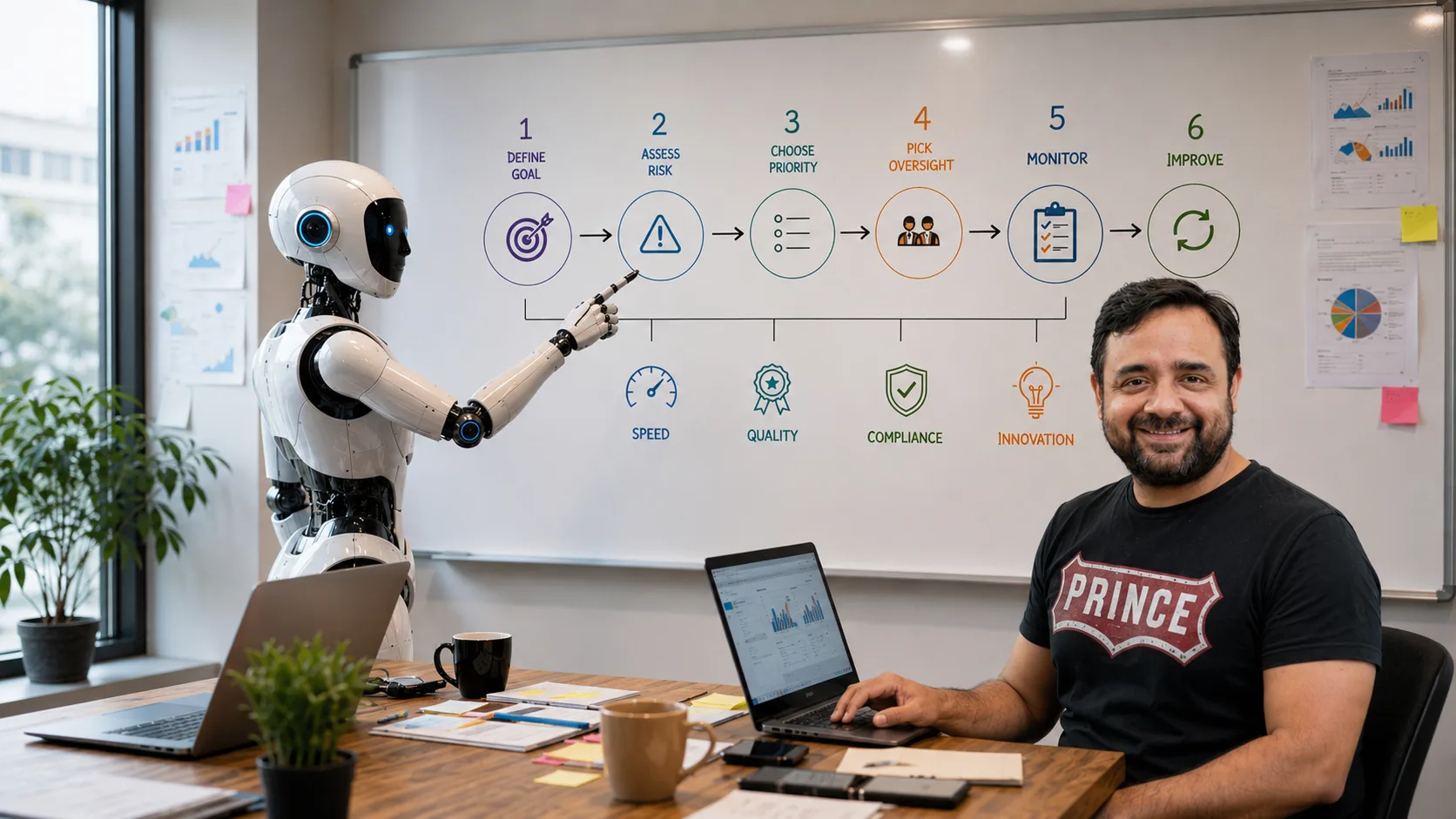
The framework identifies four different things organisations are typically optimising for when they deploy AI:
- Quality and accuracy. You care most about getting it right. Errors are costly, reputation is on the line, and precision matters more than speed.
- Compliance. There are rules — legal, regulatory, policy-based — and the system needs to stay inside them. The consequences of stepping outside aren’t just embarrassing; they’re potentially existential.
- Innovation. You’re using AI to generate new ideas, explore creative territory, or accelerate creative output. The goal isn’t to replicate what a human would do — it’s to expand what’s possible.
- Speed and volume. You need to process a lot, fast. The economics only work if the AI is handling the bulk of it.
Each category requires a different type of oversight. That’s the piece many teams miss.
Let’s look at them through the lens of a fractional UX expert.
The Four Things You’re Actually Optimising For
Here’s where Bannerman’s framework gets genuinely useful.
Most human-AI oversight discussions focus on risk in isolation.
But real business decisions aren’t just about minimising risk — they’re about what you’re trying to get done.
1. Active Control — Human Authority at All Times
This is the most hands-on mode. AI might be performing analysis, generating recommendations, or surfacing information — but no action can proceed without explicit human authorisation.
The human isn’t just reviewing; they’re deciding.
This is appropriate when consequences are irreversible, when trust in the AI system is still being established, or when the complexity of individual cases is too high for reliable automation.
If you’re building a tool that helps doctors flag potential diagnoses, active control isn’t overcautious. It’s correct.
You don’t want a system where a physician’s approval is technically required but operationally bypassed because the interface makes it too easy just to click through.
2. Human Augmentation — Human-Led With AI Support
Here, the human is still in the driver’s seat, but AI is doing meaningful work alongside them. The AI might process volume, surface patterns, or generate initial drafts — and the human shapes, adjusts, and approves.
Creative work often lives here. AI generates concepts; a designer decides which direction has legs and brings the strategic context that no model can infer from a brief alone.
This mode respects something important: AI is genuinely good at some things, and humans are genuinely good at others. The point isn’t to mix them 50/50 by default — it’s to be clear about who’s responsible for what.
3. Guided Automation — AI With Human Oversight
The relationship flips. AI is handling most of the decision-making, but humans stay close enough to catch problems.
This might mean regular audits, spot-checking samples, or setting up rule-based guardrails that the AI operates within — with humans stepping in when something trips a threshold.
The key here is that oversight doesn’t disappear — it changes form. Random sampling of AI decisions, for instance, is a real oversight mechanism.
It won’t catch every error, but it maintains calibration and surfaces systematic drift before it becomes a bigger problem.
This is where a lot of mature AI deployments end up, and where most of the real design work happens from a UX perspective.
How do you build interfaces that make human review actually useful, not just a rubber stamp?
4. AI Autonomy — Minimal Human Involvement
At the far end, the AI operates independently, and humans monitor performance at a system level rather than reviewing individual decisions.
Think fraud detection, spam filtering, content recommendation — areas where volume is enormous, individual decisions are low-stakes, and the goal is overall system performance rather than per-case precision.
Autonomy doesn’t mean abandonment. The framework specifically calls out circuit-breaker protocols here — the human authority to halt the system immediately, multiple verification steps, and clear escalation chains. Autonomy is a posture, not a permanent condition.
What This Looks Like in Practice
Frameworks are nice. Matrices are nice too.
But things become clearer when you see them in real situations.
Let’s take two examples.
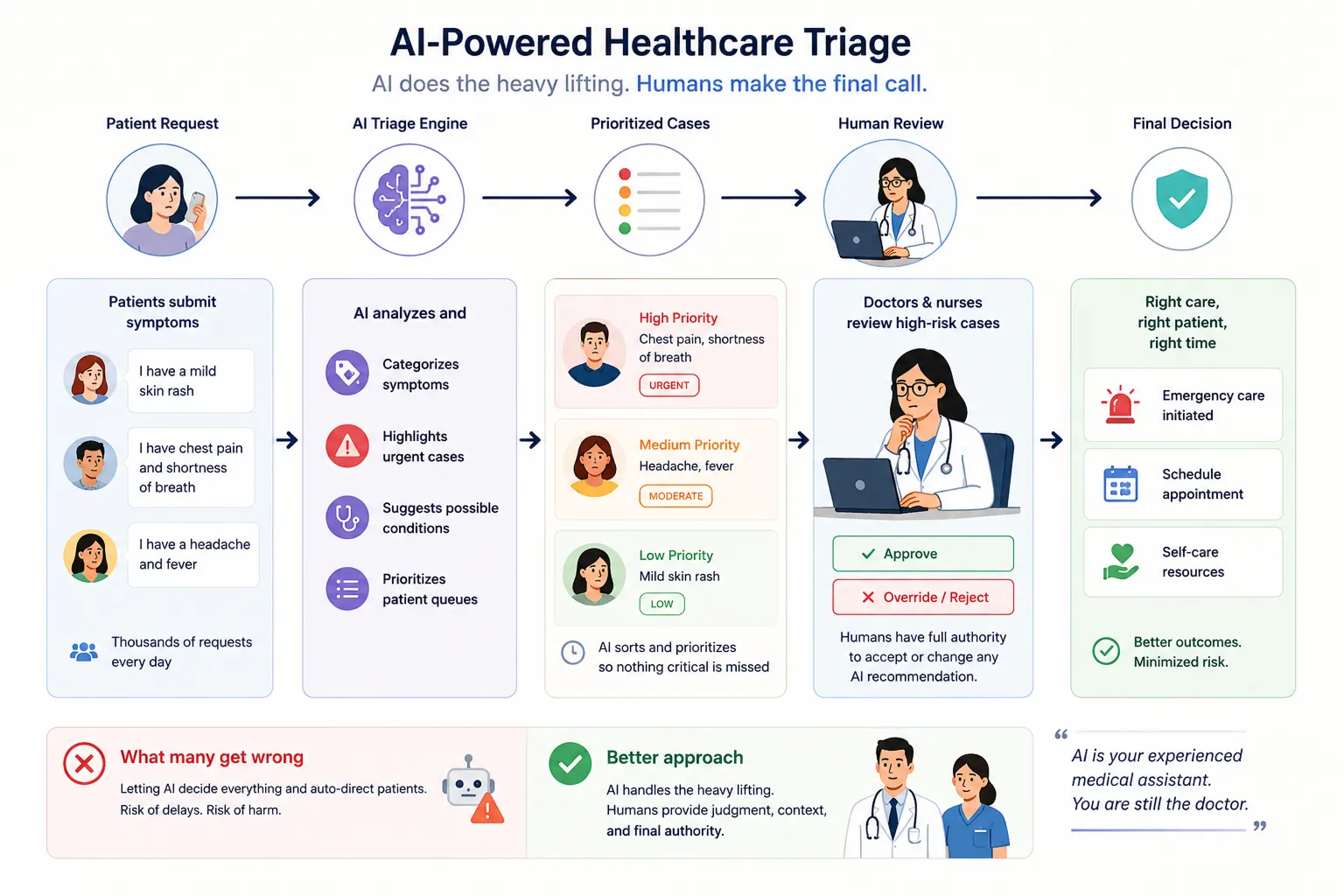
Example 1: AI-Powered Healthcare Triage
Imagine a telehealth platform handling thousands of patient requests every day.
The system uses AI to read symptoms and suggest the urgency level of each case. A patient with a mild skin rash might be directed to self-care resources, while someone reporting chest pain gets immediate attention.
Sounds efficient. It is.
But the stakes are huge.
A wrong recommendation here isn’t a minor inconvenience. It could delay treatment for someone who genuinely needs help.
This is exactly where many companies get it wrong. They think, “The AI is pretty accurate, so let’s automate the whole thing.”
That’s risky.
A better design is to let AI do the heavy lifting while keeping medical professionals firmly in control.
The AI can:
- Categorize symptoms
- Highlight urgent cases
- Suggest possible conditions
- Prioritize patient queues
Doctors and nurses then review high-risk recommendations and have complete authority to change or reject the AI’s suggestions.
The machine saves time.
The humans make the final call.
Think of it like an experienced medical assistant preparing the paperwork before the doctor walks into the room. Helpful? Absolutely. Replacing the doctor? Not even close.
Example 2: Customer Support for a SaaS Product
Now let’s move to something with much lower stakes.
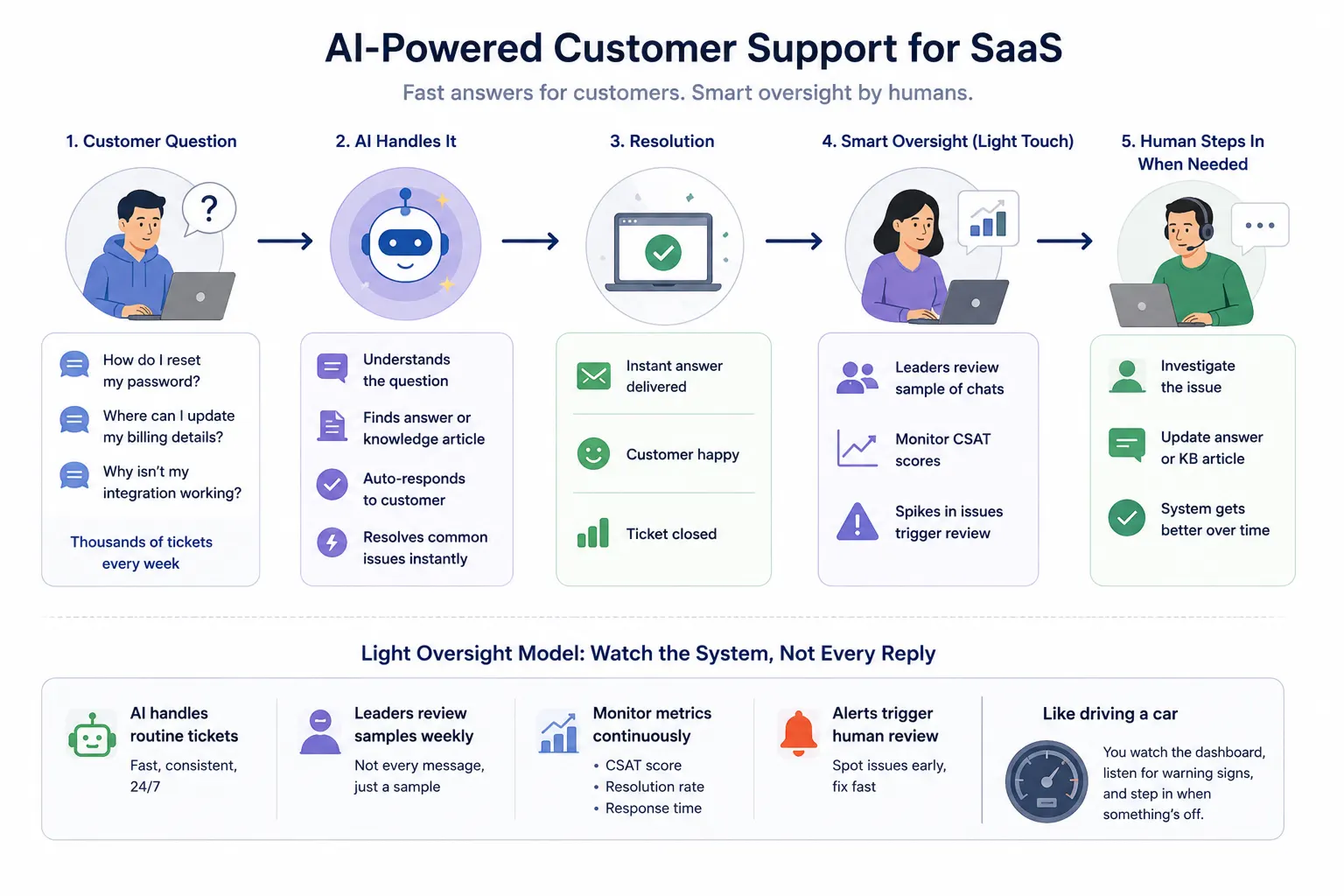
A software company receives thousands of support tickets every week.
Questions like:
- “How do I reset my password?”
- “Where can I update my billing details?”
- “Why isn’t my integration working?”
Here, speed matters.
Customers don’t want to wait three days for an answer to a simple question.
In this case, AI can generate responses automatically, suggest knowledge-base articles, and even solve common issues without human involvement.
Does every reply need a support manager to approve it?
Of course not.
That would completely defeat the purpose.
Instead, the company might use a lighter oversight model:
- AI handles routine tickets automatically.
- Team leaders review a sample of conversations every week.
- Customer satisfaction scores are monitored continuously.
- Sudden spikes in complaints trigger a human investigation.
Nobody is checking every message.
They’re checking the health of the system.
It’s a bit like driving a car. You don’t stop every five minutes to inspect the engine. You watch the dashboard, listen for strange noises, and step in when something feels off.
These two examples look very different, but they follow the same principle.
AI is making decisions.
Humans remain involved.
The difference is in the design of that involvement.
Healthcare requires strong human authority because the consequences are serious.
Customer support can rely more heavily on automation because mistakes are usually recoverable.
Same technology.
Same idea of “keeping humans in the loop.”
Completely different oversight models.
And that’s really the point.
The right human-AI relationship isn’t determined by the tool itself. It’s determined by what you’re trying to achieve, how much risk you’re willing to accept, and what happens when the system gets something wrong.
Where the Fractional UX Expert Fits Into All This
You know what nobody tells you when you start doing fractional work? You’re often the first person who’s actually coherently asked these questions.
Your clients are building products fast. They’re integrating AI because they have to, or because a competitor did, or because a board member asked why they weren’t using it.
The oversight model — if one exists — is usually bolted on after the fact. Or it’s so vague it offers no real protection.
This is actually where you can add serious value, well beyond UI deliverables.
When you’re doing a UX audit that touches AI features, the Bannerman framework gives you a diagnostic lens.
You can ask: what is this feature optimising for? What are the actual failure modes? Where does human judgment currently live in this flow — and is that the right place for it?
You don’t have to come in as an AI ethicist. You come in as someone who cares about how the product actually works for the people using it.
And “a human reviews it at some point” is not a user experience. It’s a gap in the design.
There’s also a workflow design angle here that’s underexplored. A lot of human-in-the-loop failures aren’t technical — they’re interface failures.
The human reviewer sees a wall of AI output with no clear indication of confidence levels, flagged exceptions, or escalation paths.
They click through because the interface doesn’t make a meaningful review possible. That’s a design problem. That’s your territory.
The Part People Skip: Deciding What Mode You’re In
One thing the framework makes clear — and that most implementations miss — is that you have to choose a mode. Deliberately. Out loud. With stakeholders in the room.
“We’ll have humans review it” is not a decision. It’s a deferral.
A real decision sounds like: “For this feature, we’re operating in guided automation mode. That means the AI handles the initial pass, a team member audits 10% of outputs weekly, and there’s a clear escalation path for any decision flagged as high-stakes. We revisit this in 90 days based on error rate data.“
The framework also acknowledges that different parts of the same product can operate at different levels. Your content recommendation system might run at near-full autonomy while your customer support escalation system uses active control. That’s not inconsistent — it’s appropriate, if the decision was made consciously.
A Few Things Worth Watching
No framework is complete, and this one is no exception. A couple of considerations worth carrying alongside it:
- Oversight fatigue is real. When humans are asked to review AI decisions at high volume with no real authority to change them, they stop paying attention. The review becomes theater. If you’re designing a guided automation workflow, the interface has to make review worthwhile — which means surfacing the right signals, making disagreement easy, and ensuring human input actually feeds back into the system.
- The mode you choose shapes the model you get. This is a subtler point. If you build AI systems where humans always defer to AI output, you train both the humans and, implicitly, future model iterations toward that deference. Feedback learning only works if the humans in the loop are actually engaged enough to generate meaningful feedback.
- Autonomy creep happens slowly. Teams start with active control, get comfortable, shift to guided automation, and gradually reduce the review burden until they’re effectively at autonomy — without ever making that decision explicitly. Periodic reviews of your oversight model aren’t bureaucracy. They’re maintenance.
Need help building better digital products?
I’m Prince Pal Singh, a Fractional UI/UX Design Expert with 18+ years of experience helping startups and enterprises turn ideas into intuitive, scalable, and user-centered products.
From product strategy and UX research to design systems and AI-powered experiences, I partner with teams to solve complex problems and create products people love to use.
📩 Looking for a strategic design partner without hiring a full-time team?
The Takeaway
Here’s the interesting part.
Companies don’t need more prompts.
They don’t need another AI tool.
They need people who can design relationships between humans and machines.
That’s a different skill.
A fractional UX expert is well-positioned to lead this work.
You understand:
- User behavior
- System thinking
- Business goals
- Risk management
- Decision making
Those skills matter even more in the age of AI.
Maybe that’s the biggest twist of all.
The rise of artificial intelligence isn’t reducing the need for experienced UX professionals.
It’s increasing the need for people who know when humans should stay involved, when they should step back, and when they should take control.
The future probably won’t belong to teams that automate everything.
It will belong to teams that know exactly where humans still matter.
Common FAQs
1. What is Human-AI Oversight, and why does it matter?
Human-AI Oversight is the process of deciding how humans and AI systems work together. It defines when AI can act independently, when humans should review decisions, and when human judgment must take full control.
The goal isn’t to slow AI down. It’s to create the right balance between automation, business efficiency, and responsible decision-making.
2. Is Human-AI Oversight the same as Human-in-the-Loop?
Not exactly.
Human-in-the-Loop usually means adding a person somewhere inside an AI workflow to review or approve decisions.
Human-AI Oversight goes further. It asks deeper questions:
- What are we trying to improve?
- What happens if AI makes a mistake?
- Who owns the final decision?
It focuses on designing the right level of human involvement instead of adding unnecessary approval steps everywhere.
3. How can a Fractional UX Expert help with Human-AI Oversight?
A Fractional UX Expert helps businesses design AI experiences where humans and technology work together effectively.
They help teams:
- Map AI workflows
- Identify high-risk decisions
- Create review processes
- Improve user trust
- Design better AI interactions
The focus is making AI useful without removing important human judgment.
4. When should humans step into an AI decision-making process?
Humans should step in based on risk and impact.
For example:
Low-risk tasks like organizing data or creating summaries may need minimal review.
High-impact decisions like healthcare recommendations, hiring decisions, or financial advice require stronger human involvement.
The bigger the consequence, the more human control is needed.
5. Can AI replace UX designers or product experts?
AI can support UX designers, but it cannot fully replace human thinking.
AI is good at:
- Processing large amounts of information
- Finding patterns
- Generating ideas
- Speeding up repetitive tasks
UX experts bring:
- Empathy
- Business understanding
- Ethical judgment
- User context
- Creative problem-solving
The strongest results come from humans and AI working together.
6. How can businesses start building a Human-AI Oversight Framework?
Start with three simple questions:
- What should AI help us achieve?
- What happens if AI gets something wrong?
- Where do humans provide the most value?
From there, choose the right oversight model:
- AI autonomy for simple tasks
- Guided automation for routine decisions
- Human review for important decisions
- Human control for high-risk situations
A good framework doesn’t add more approvals — it puts human expertise exactly where it matters.