
Judgment Is The Advantage
Everyone Can Build Now. So What Are You For?
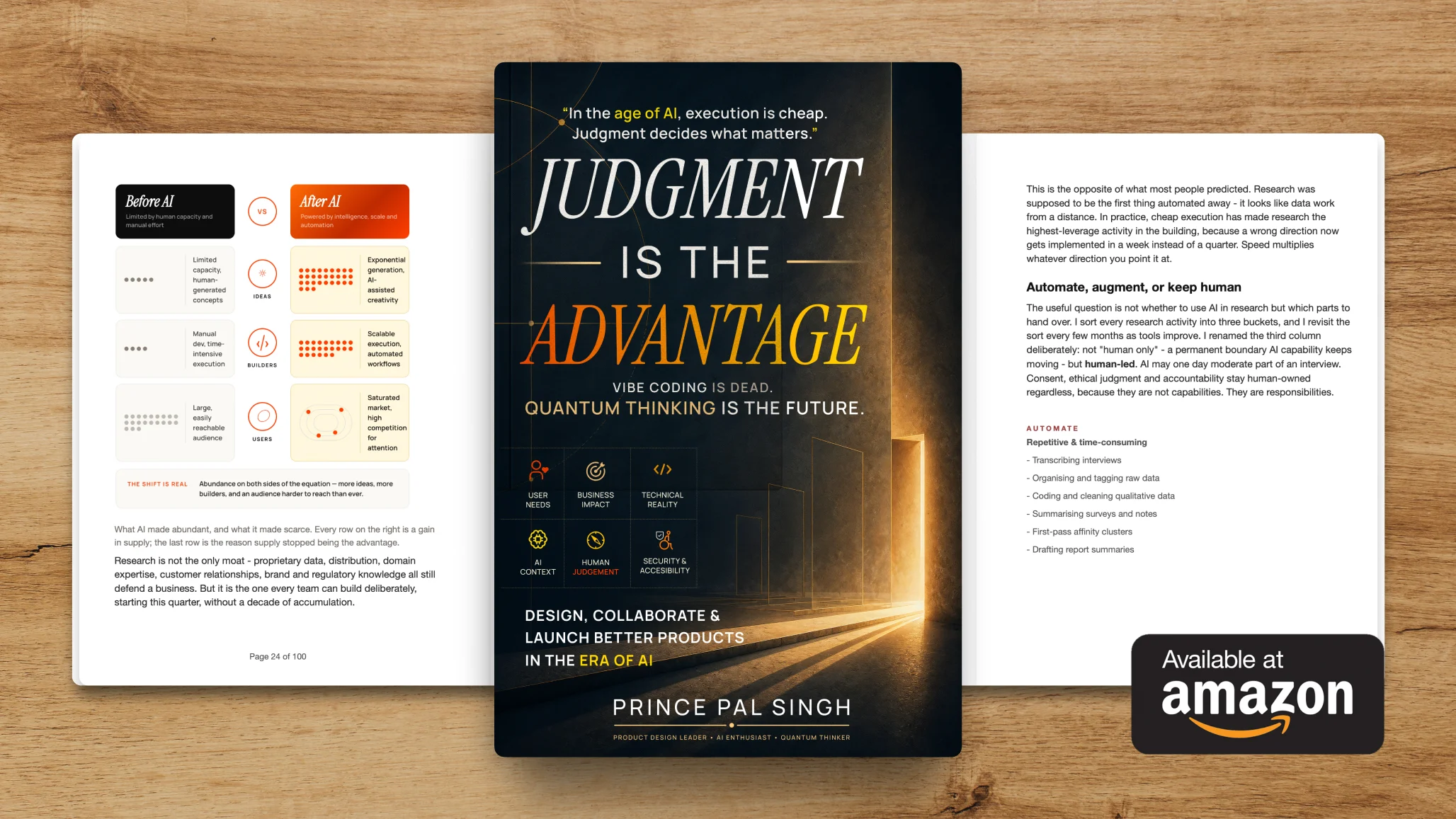
AI made execution cheap. It did not make judgment cheap. This is the field book for teams who have to tell a good result from a plausible one — eighteen years of practice, written down.
Paperback & Kindle · Or take the first chapter and the nine-prompt library free, no purchase needed.
18 yrs
in product teams across five industries
60M+
people reached by products shipped
6
appendices you can use on Monday
Sound familiar?
Your Team Got Faster. Did The Product Get Better?
Three questions came back after every talk. The whole book is an attempt to answer them properly.
1
Engineering moves faster than your process.
A fortnightly review is not a rhythm when producing an option costs four seconds. It is a queue.
2
A hundred options an hour, and no decision.
Ten concepts do not contain a decision. They contain ten postponements of one.
3
Everything is buildable. Nothing is obvious.
When the constraint stops being capacity, the constraint becomes knowing what deserves to exist.
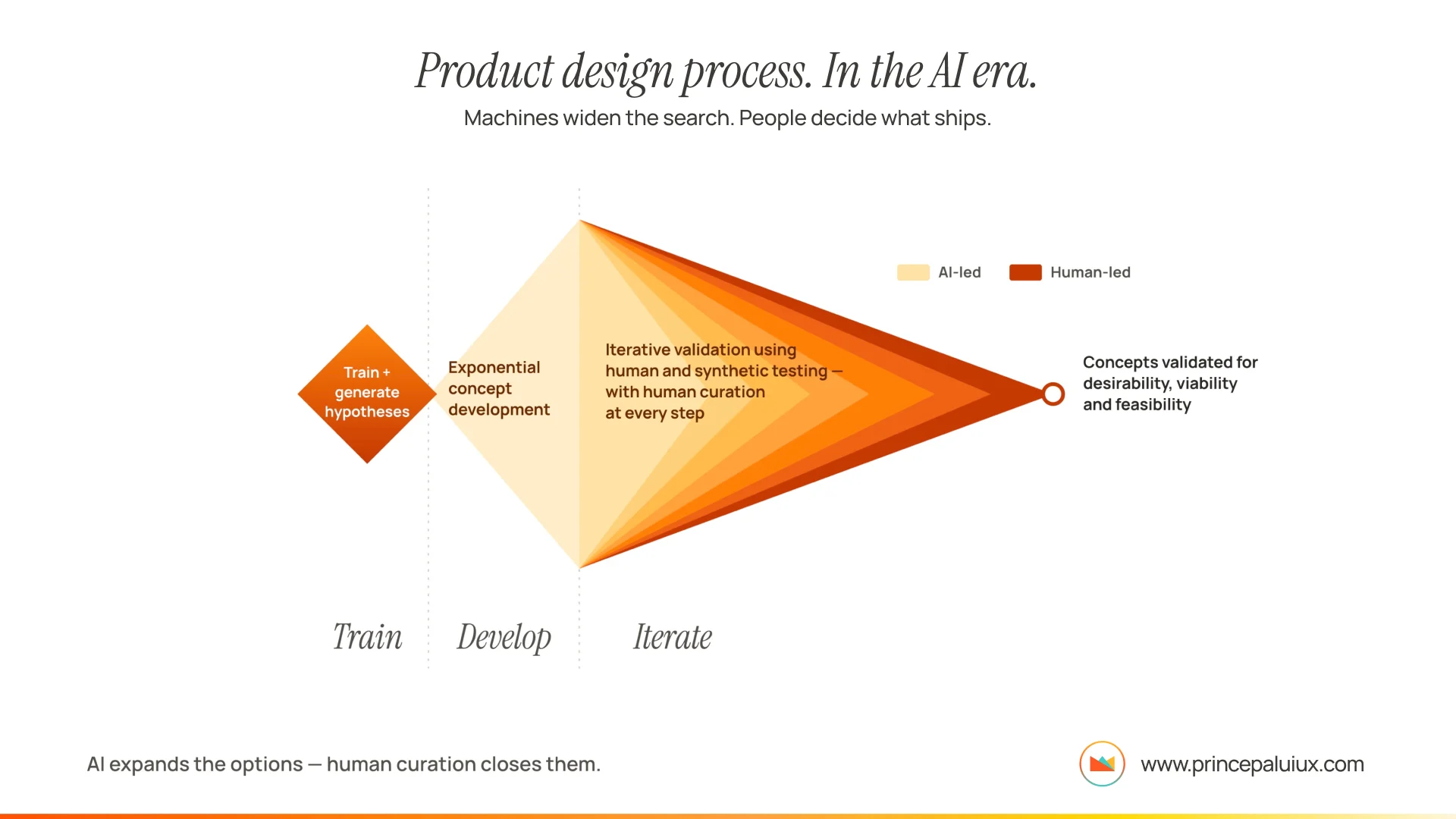
AI lowers the cost of execution. It raises the value of judgment and experience.
The argument of the book, in one sentence
Not opinions — evidence
Both Of These Numbers Are True.
Spotify’s engineering organisation reports 76% more pull requests — and 76% more pull requests to review. A randomised trial by METR found experienced developers were 19% slower with AI, while believing they were 20% faster.
Neither result is a fluke. They describe different systems. Chapter two shows you which one you are running.
+76%
pull-request volume at Spotify — and the same rise in review load
15 yrs
of platform and test investment that made the gains safe
−19%
measured speed for experienced devs in a controlled trial
5 / 7
AI product failures are decision failures, not model failures
What’s inside
Six Parts, Shaped Like A
Product’s Life.
Twenty-five chapters. Every one ends with a Practice — the part to argue about with your team.
Part one · ch 1–2
Why Now
Two forces pulling in opposite directions — and why motion isn’t movement.
Part two · ch 3–6
Product & Engineering
The four questions every decision answers, and the fifth nobody budgets for.
Part three · ch 7–10
The New Craft
From screen designer to decision architect. Understanding becomes the moat.
Part four · ch 11–12
Working Together
Critique that makes designers better, and prototyping that stays fluid.
Part five · ch 13–17
Launching
Deciding what not to build, and quantum coding instead of vibe coding.
Part six · ch 18–25
The Operating Model
The judgment stack, calibrated trust, agents, adversaries, accessibility.
Free — no purchase needed
Try The Book On Your Own Team First.
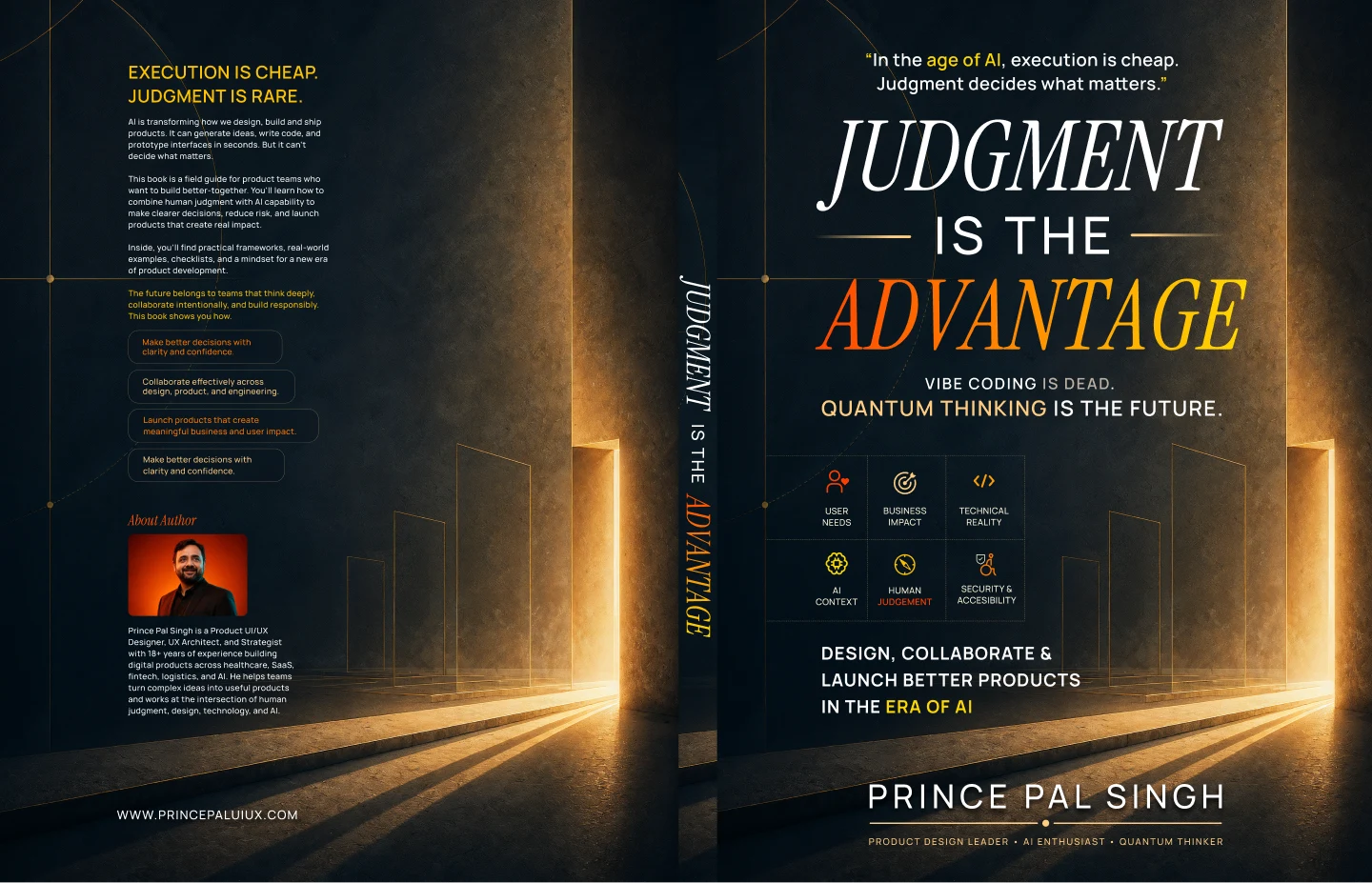
Send me where you are, and I’ll send back chapter one, the nine-prompt working library, and the four checklists. Read them in a meeting this week and see whether they change the conversation.
I mostly work in
Design
Product
Engineering
Founder/Exec
In the pack
Chapter one — Two forces reshaping how we build
The full chapter, including the Practice exercise.
Appendix B — A working prompt library
Nine prompts for discovery, design and launch. Copy-paste ready.
Appendix C — Four checklists
Before design, before handoff, before AI work, before release.
Appendix D — The seven AI product failures
A shared vocabulary for post-mortems, one page.
Where to start
Three Ways In, Depending On Your Monday.
Designers
Start At Part Three
Keep taste in a workflow that generates a hundred options an hour — and turn it into a decision your team can read back.
Product managers
Start At Part Two
Five questions every decision answers, including what the model needs to know and what being wrong costs.
Engineering leaders
Start At 14 And 17
Build for the next version, and quantum coding — the named alternative to accepting output because it looks right.

The author
Prince Pal Singh
UX Architect · Designer · Strategist
This book began as sixty minutes on a stage. Sixty minutes was not enough.
Eighteen years inside product teams across healthcare, SaaS, fintech, logistics and AI. Products used by more than sixty million people. The pattern that predicted a good outcome was never the quality of the individual designer — it was the quality of the conversation between design, product and engineering.
Everything here is written as practice rather than opinion, and therefore arguable. That is the invitation.
Before You Buy.
No. Prompts change every quarter — the way three disciplines make a decision together has not changed in twenty years. There is a prompt library in Appendix B because it is useful, not because it is the point.
Product designers, UX designers, product managers, engineers, founders, researchers, and team leaders using AI.
No. It focuses on practical ways to think and work with AI.
A product thinking approach that connects users, business, technology, data, AI, and consequences.
AI-assisted development based on documented intent, tested assumptions, verified results, and preserved systems.
It is written for the three disciplines in the room. Product managers start at Part two, engineering leaders at chapters 14 and 17, designers at Part three. The vocabulary is deliberately shared.
Both, on Amazon. The appendices are designed to be marked up, so most teams end up with the paperback on the desk and the Kindle for the commute.
Sometimes. Take the free chapter first, then reply to the email that carries it and say what your team is stuck on.
The next chapter of design is yours.
Execution has become cheap. Judgment has not. Start with the free chapter, or take the whole field book.
Book’s Keywords Cloud
AI, artificial intelligence, AI product design, AI product development, AI in UX, AI in design, AI design, AI UX design, UX design, UI UX design, product design, product designer, UX designer, product management, AI product manager, AI tools for designers, AI tools for product designers, human AI collaboration, human AI interaction, human AI design, AI collaboration, AI workflow, AI product workflow, AI powered design, AI assisted design, AI assisted development, AI assisted coding, AI coding, AI software development, vibe coding, vibe coding alternative, quantum coding, Quantum Thinking, quantum thinking framework, decision architecture, Decision Architect, product decision making, AI decision making, human judgment, judgment in AI, AI judgment, human judgment in AI, judgment is the advantage, Judgment Is The Advantage book, AI book, AI design book, product design book, UX design book, AI UX book, product management book, AI product development book, future of product design, future of UX design, future of AI, future of product development, future of designers, AI for designers, AI for UX designers, AI for product managers, AI for developers, AI for engineers, ChatGPT for designers, Claude for designers, Figma AI, Notion AI, Framer AI, ChatGPT product design, Claude AI product design, generative AI, generative AI design, generative AI product development, generative AI UX, AI prototyping, AI prototype, AI product prototype, AI research, AI UX research, AI product strategy, AI design strategy, AI innovation, AI startup, AI startups, building AI products, designing AI products, launching AI products, AI product strategy, product strategy with AI, design collaboration, product design collaboration, design engineering collaboration, product engineering collaboration, designer developer collaboration, product designer and engineer, design systems AI, AI design systems, AI workflow for designers, AI workflow for product teams, AI productivity, AI productivity tools, AI creative process, AI creative workflow, AI brainstorming, AI ideation, AI user research, AI usability testing, AI accessibility, AI product launch, product launch strategy, product launch with AI, AI feature launch, AI feature development, MVP product design, MVP development, product discovery, product discovery with AI, product thinking, strategic product design, design thinking AI, AI design thinking, AI transformation, AI native products, AI first products, AI era, AI future, AI trends, AI technology, responsible AI, responsible AI design, responsible AI development, AI product risks, AI ethics, AI evaluation, AI testing, AI generated code, AI code generation, AI coding tools, AI software engineering, AI development workflow, AI assisted software engineering, AI and UX, AI and product management, AI and engineering, AI and design, designers using AI, product teams using AI, working with AI, AI as a companion, AI thinking partner, AI thought partner, better AI decisions, better product decisions, better design decisions, AI decision support, continuous decision making, product judgment, design judgment, product leadership, design leadership, AI leadership, UX leadership, technology leadership, Prince Pal Singh, Prince Pal, AI product designer, AI UX expert, product UI UX designer, UX architect, Judgment Is The Advantage book review, Quantum Thinking Playbook, Quantum Thinking Playbook AI, Design Collaborate Launch with AI, design collaborate launch, AI product design workflow, AI collaboration workflow, AI for product teams