
AI makes building faster, but speed isn’t enough. Learn how designers, founders and product teams can use AI to research, collaborate, make better decisions and launch products people value.
AI has made something strange happen.
Building has become easier. Deciding what deserves to be built has become harder.
A designer can create several interface concepts before lunch. A founder can turn an idea into a working prototype over a weekend. Developers can generate code, tests, documentation, and debugging suggestions with a few prompts.
It feels like progress. Often, it is.
But faster output doesn’t automatically create a better product.
A team can produce ten times more and still solve the wrong problem.
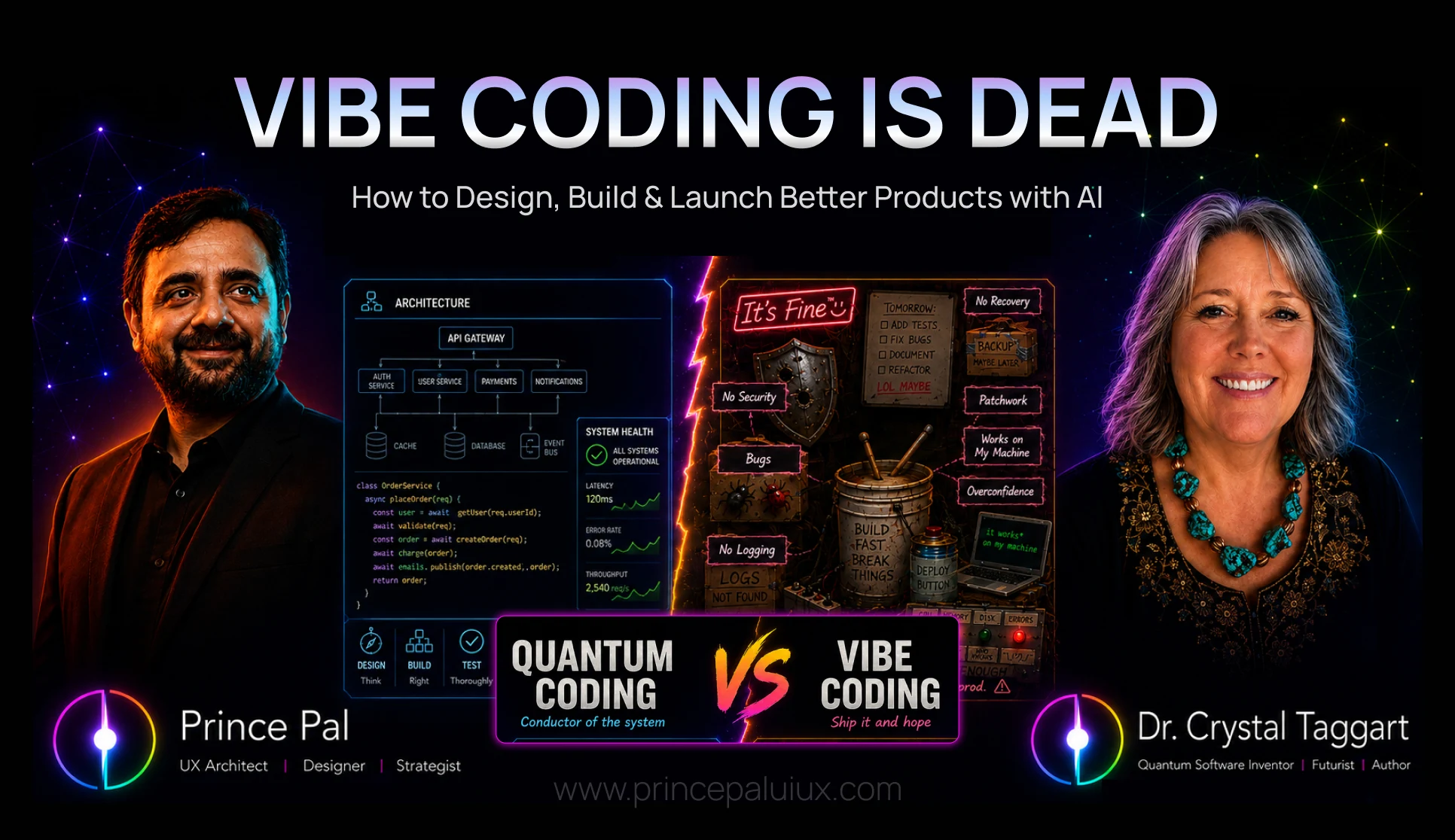
That tension sits at the centre of Design, Collaborate & Launch with AI, a conversation between Prince Pal, UX Architect and Product Designer with 18+ years of experience, and Dr. Crystal Taggart, Quantum Software Inventor, AI Futurist, and founder of One Machina and Cinemachina.
The discussion covers product design, UX research, engineering, AI-assisted development, product launches, and a bigger question:
What happens to our skills when AI makes execution cheap?
The answer may be uncomfortable.
Your ability to produce things isn’t disappearing. It’s becoming less rare.
Your judgment is becoming the valuable part.
Vibe Coding Is Dead. Or Maybe Blind Vibe Coding Is.
“Vibe coding” captured the imagination of builders for a good reason.
Describe what you want. Let AI write the code. See what happens. Fix it. Ship.
For experiments and quick concepts, that can feel almost magical.
The problem starts when experimentation gets confused with product development.
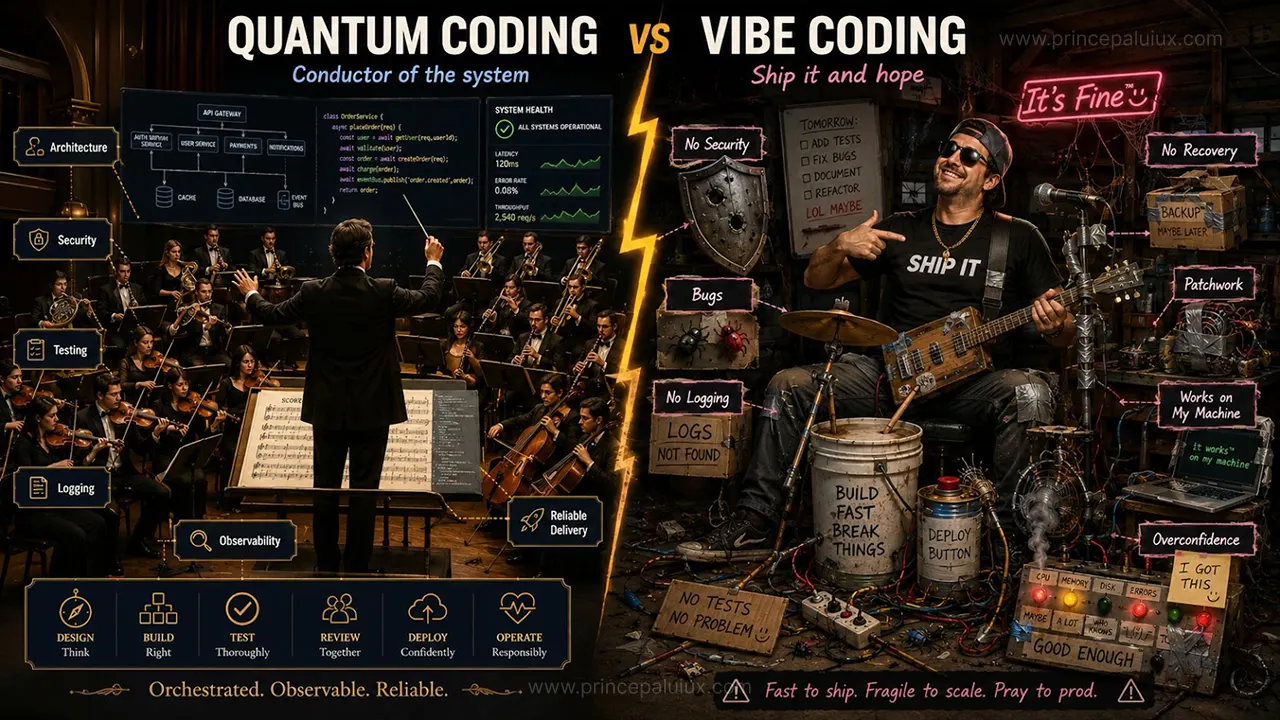
The episode presents a case in which a developer made three seemingly small changes using AI. The output came quickly, but the process around it broke down.
The wrong branch was used. Requirements were missed. Existing functionality changed. New behaviour appeared without approval. Testing wasn’t completed before the work was checked in.
Fast output created slow delivery.
That’s the contradiction at the centre of AI-assisted development.
AI can make you faster and still make the project slower.
The presentation describes an alternative as Quantum Coding: document intent, validate assumptions, test the result, and preserve knowledge about the system.
AI can write the code.
The engineer still owns the outcome.
That distinction matters far beyond software engineering.
A founder using AI to write a landing page still owns the promise being made.
A designer generating an interface still owns the experience.
A marketer generating a campaign still owns the message.
AI gives you output. It doesn’t take responsibility for what happens next.
Execution Is Getting Cheaper. Judgment Isn’t.
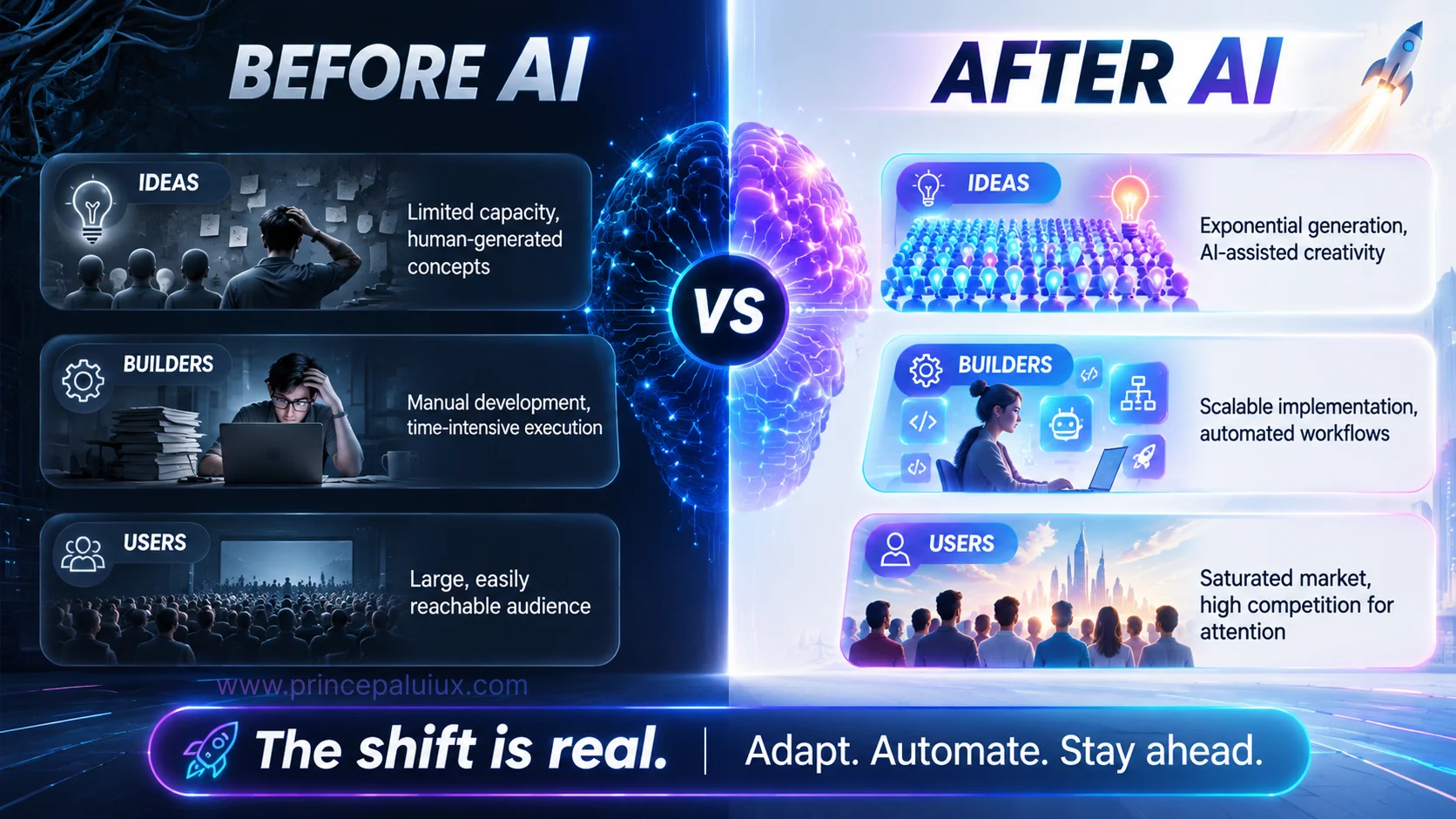
For years, execution was expensive.
You needed specialists, software, development time, budgets, and sometimes months of work to turn an idea into something people could actually use.
AI is compressing much of that.
Ideas can become mockups.
Mockups can become interactive prototypes.
Prototypes can become functioning front ends.
Research notes can become structured findings.
A rough product concept can become a mini-PRD, user stories, edge cases, UX copy, onboarding flows, and launch material remarkably quickly.
That changes where professional value sits.
Dr. Crystal Taggart captures the shift in one sentence from the episode:
“AI lowers the cost of execution. It raises the value of judgment and experience.”
That’s worth sitting with.
If everyone has access to powerful generation tools, producing another screen or another block of code becomes less impressive.
Knowing why that screen should exist becomes more valuable.
Knowing what should be removed matters.
Knowing which customer problem deserves attention matters.
Knowing that an AI-generated answer sounds convincing but is wrong? That matters a lot.
AI fluency gives people capacity.
Judgment decides where that capacity goes.
The Product Designer Is Becoming a Decision Architect
Product design has already changed several times.
In the 1990s, the challenge was often: Can people complete the task?
During the 2000s, usability became a stronger discipline. Information architecture, user flows, and usability testing moved closer to the centre.
The 2010s brought mobile-first thinking, responsive experiences, component libraries, and design systems.
Then collaborative tools, reusable UI kits, no-code platforms, and low-code products accelerated interface creation.
Now AI is pushing the profession through another shift.
AI can generate layouts, copy, components, and even functioning code.
So the question changes again:
Is this the right experience to build?
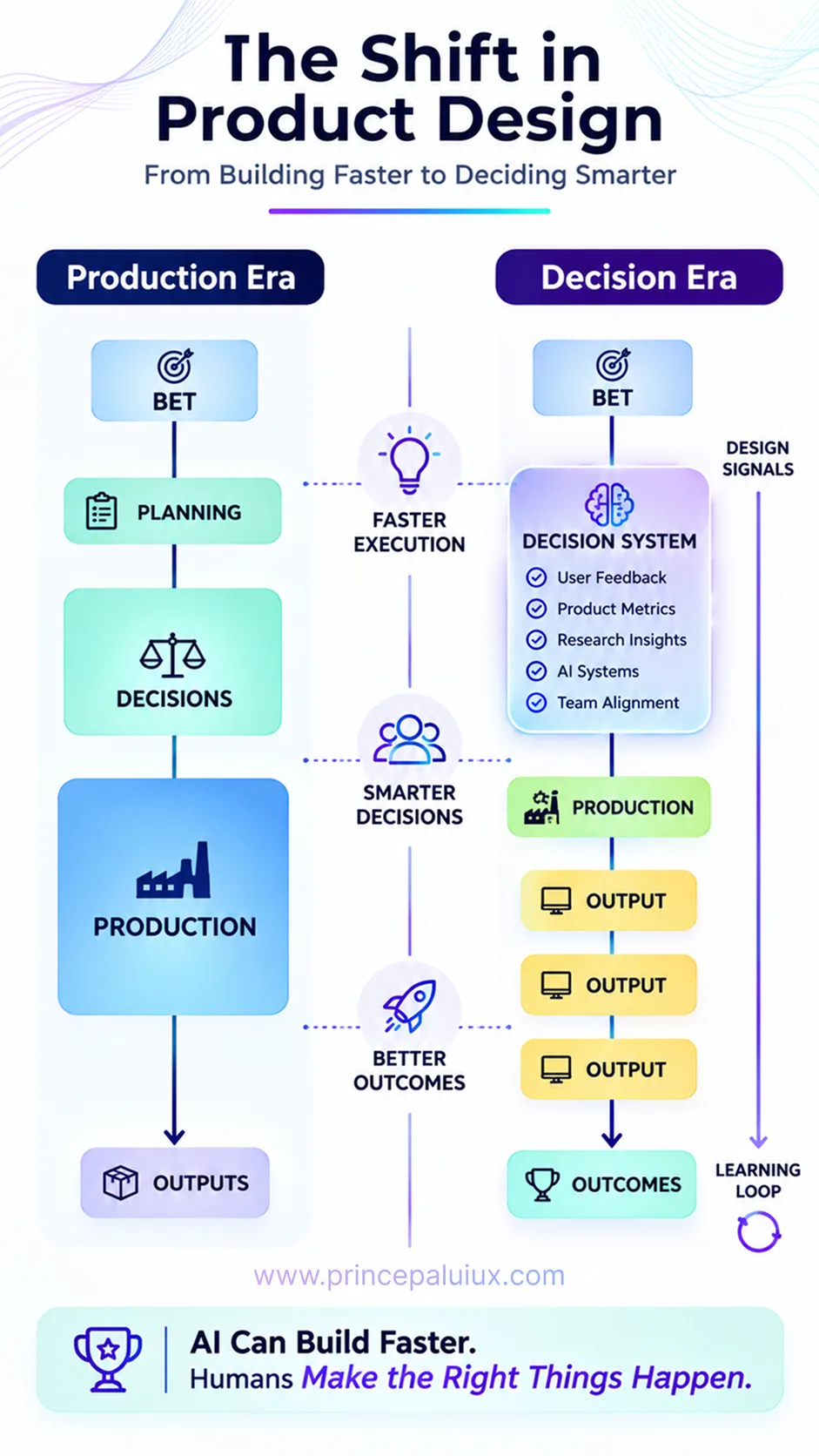
The episode describes the UX designer’s role moving from screen designer to decision architect.
That’s a much bigger job than choosing typography and arranging cards.
It means connecting user needs with business goals and technical reality.
It means asking awkward questions before a team spends three months building something nobody asked for.
It means bringing context, ethics, empathy, strategy, and taste into decisions where AI can provide options but can’t carry human accountability.
The pixels still matter.
They’re no longer the whole job.
Here’s the Catch: AI Makes UX Research More Valuable
You might expect AI-generated products to reduce the need for UX research.
The opposite may happen.
Why?
Because ideas are no longer scarce.
Imagine two founders.
One spends three months building a prototype.
The other describes an idea to an AI tool and has something interactive that afternoon.
The cost of trying ideas drops dramatically.
Soon everyone has ideas.
Everyone has prototypes.
Everyone has features.
Then what separates a useful product from the thousands of forgotten experiments?
Knowing what people actually need.
The episode makes this point directly: as execution becomes faster, understanding people, finding meaningful problems, and making sound decisions become stronger sources of competitive advantage.
AI has a role in research, of course.
It can transcribe interviews, organise raw data, clean qualitative findings, summarise surveys, suggest research questions, surface patterns, and propose hypotheses.
Yet some work remains deeply human.
Moderating an interview.
Building trust.
Reading hesitation.
Recognising that a participant’s words and behaviour don’t quite match.
Making an ethical call.
Deciding which finding has real product significance.
And, perhaps most important:
Deciding what’s worth building.
AI can help researchers process evidence.
Humans still have to interpret what it means.
Don’t Ask AI for Better Answers. Give It Better Inputs.
There’s another misconception hiding inside AI productivity.
People spend a lot of time searching for the perfect prompt.
The episode takes a broader view.
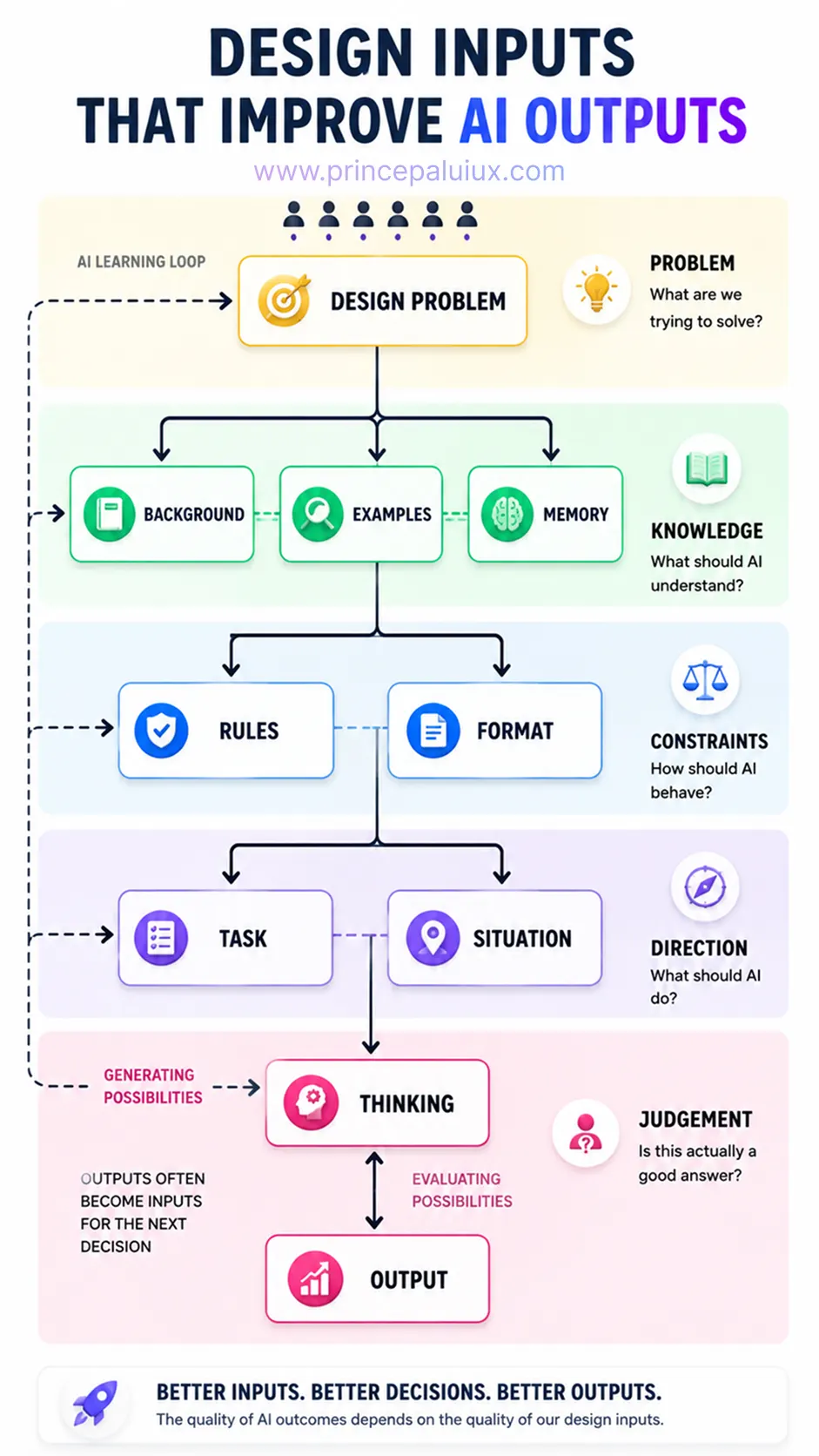
The quality of an AI response is shaped before anyone presses Generate.
Five inputs matter:
- Problem: What are we trying to solve?
- Knowledge: What does the AI need to know?
- Constraints: What rules should it respect?
- Direction: What do we want it to produce?
- Judgment: Is the result any good?
That last one changes everything.
You can feed a vague product idea into ChatGPT and receive a polished answer.
Polished doesn’t mean correct.
This is where experience becomes visible.
An experienced designer notices the missing state.
A product manager spots the business assumption.
An engineer sees the security risk.
A researcher notices that the proposed solution contradicts what users actually said.
AI doesn’t remove expertise.
It gives expertise a larger surface area.
Design, Product, and Engineering Need Each Other Earlier
There’s a familiar way to build software.
Product writes requirements.
Design makes screens.
Engineering receives the handoff.
Then someone discovers a problem.
Back it goes.
The episode argues for a more collaborative model.
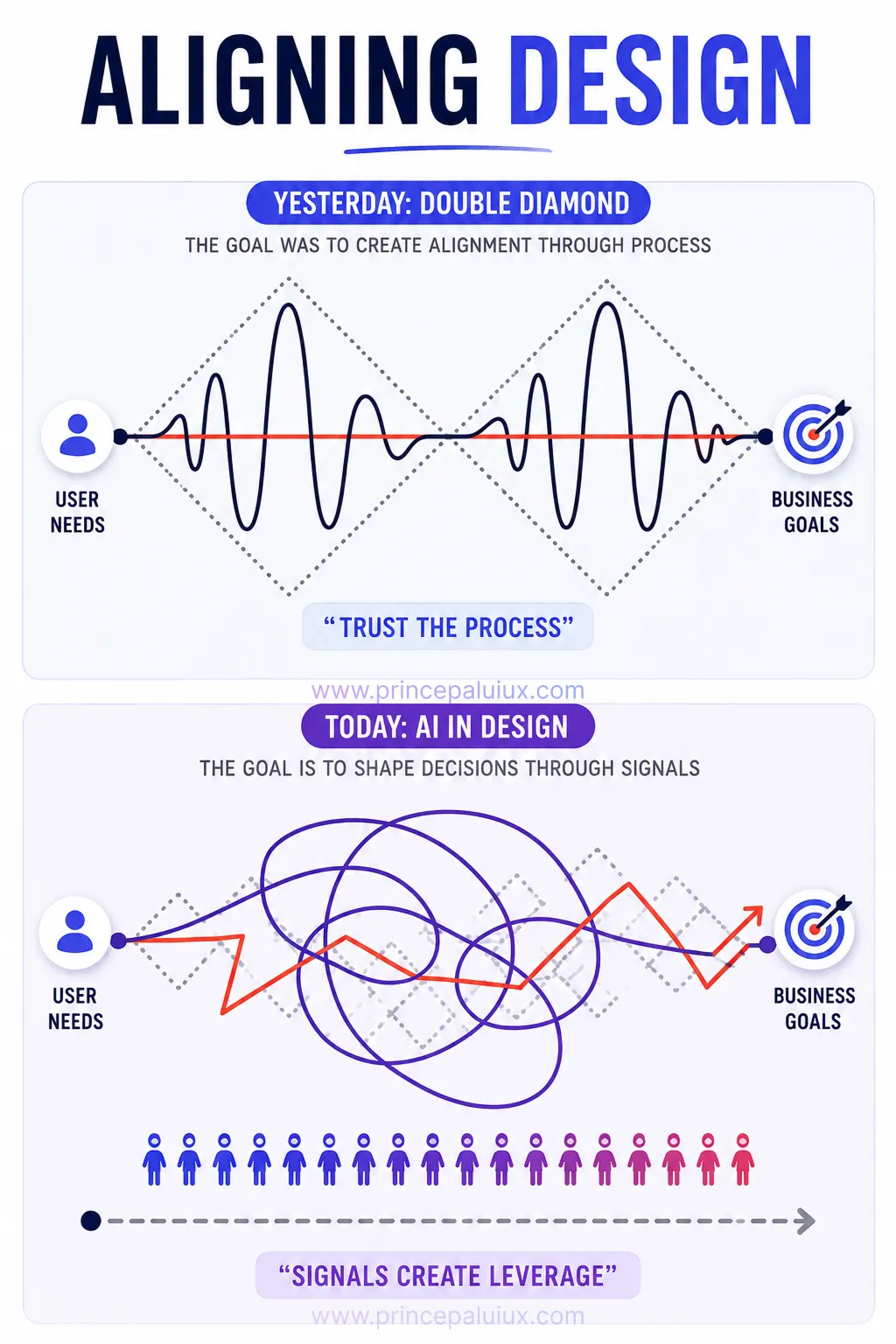
User needs, business goals, and technical feasibility should meet early rather than appearing as separate checkpoints.
That means requirements need clarity.
User stories, acceptance criteria, assumptions, and edge cases should be written down.
Handoffs need intent, not a pile of Figma frames with arrows everywhere.
Trade-offs need to be visible too.
Speed versus quality.
Business needs versus user needs.
Technical feasibility versus an ideal experience.
AI can help teams explore those tensions. ChatGPT can draft PRDs and user stories. Claude can examine requirements and flag edge cases. Meeting notes can become action items. Stakeholder updates can be drafted in seconds.
Yet the team still decides.
That’s the pattern you’ll keep seeing:
AI proposes. Humans judge. Teams decide.
AI Is Changing the Design Handoff Too
Here’s a change designers should pay close attention to.
The traditional handoff usually involved mockups, interaction notes, design specifications, and Figma files.
A developer then translated design intent into software.
AI-native design tools are beginning to shrink that gap.
The presentation describes the front end becoming a design deliverable, with design handoff gradually moving closer to code handoff.
A designer can increasingly create working layouts, reusable components, navigation, responsive behaviour, and interaction logic before engineering takes over.
Does that make developers irrelevant?
No.
Their focus can move deeper into production concerns: APIs, databases, authentication, permissions, business rules, security, optimisation, testing, and production architecture.
Designers aren’t becoming engineers overnight.
Engineers aren’t becoming unnecessary.
The boundary is simply moving.
And moving boundaries require better collaboration, not less.
From Idea to Launch: Build Less, Learn More
AI makes adding features dangerously easy.
“Could we add this?”
Yes.
“Can AI build it?”
Probably.
“Should we?”
Ah. Different question.
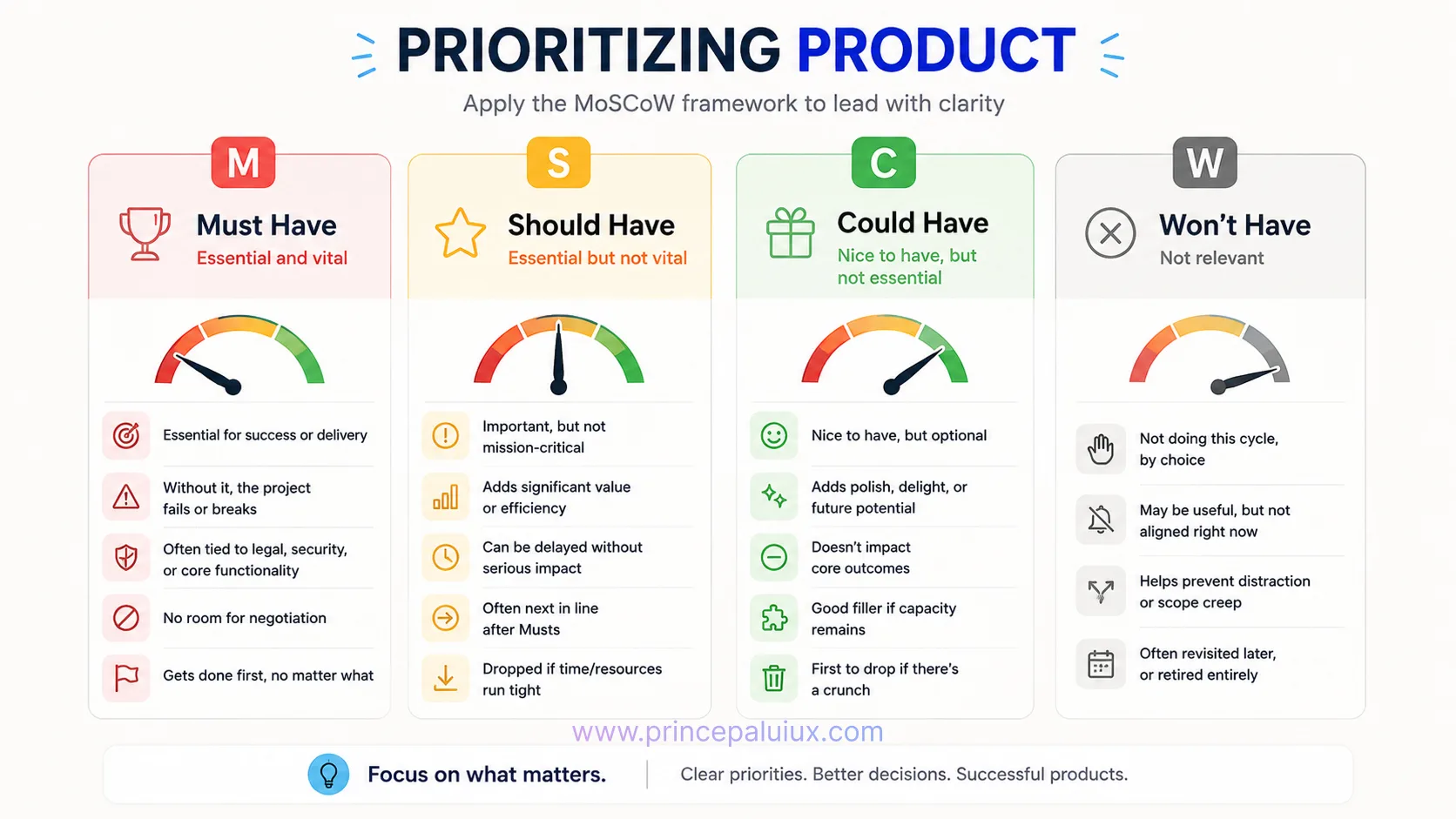
The episode uses the MoSCoW method to frame product priorities:
Must have. Should have. Could have. Won’t have.
That last category deserves more respect.
Good product strategy often means deciding what won’t be built.
The discussion then introduces Minimum Lovable Product (MLP) thinking: create the smallest solution that tests your assumptions and gives users genuine value.
Identify the core value.
Compare impact with effort.
Build enough to learn.
Resist feature creep.
This becomes even more useful when AI makes producing another feature feel almost free.
Software isn’t free simply because generating code became cheaper.
Every feature creates future decisions, testing, support, documentation, maintenance, security concerns, and user expectations.
Sometimes the smartest feature is the one you never build.
Plan for Rework Instead of Pretending You’ll Avoid It
Products change after people use them.
That’s normal.
Real users expose missing requirements. New workflows reveal edge cases. Feedback challenges assumptions.
The episode suggests treating rework as part of product planning rather than proof that the first version failed.
Refactor with intent.
Group related bugs and improvements around capabilities.
Let versions coexist when a new workflow represents a meaningful change.
Cinemachina provides an example.
Its original workflow generated frames from dialogue lines. A storyboard-first idea later reframed the experience around scenes. Instead of forcing the new concept into the old structure, a second capability was created, eventually developing into a new standard for movies and trailers.
There’s a useful product lesson hiding there.
Don’t protect Version 1 simply because you worked hard on it.
Learn from it.
AI Fluency Isn’t Enough
Knowing ChatGPT is useful.
Knowing Claude is useful.
Learning AI prototyping tools is useful.
But tool knowledge has a short shelf life.
Today’s favourite interface could be replaced next year.
The greater skill is knowing how to think with these systems.
The presentation puts it neatly:
More output is not the same as more impact. Motion isn’t movement.
A designer can generate ten concepts and avoid making the difficult decision.
A developer can close more tickets and create more rework.
A company can automate dozens of tasks without solving a customer problem.
That’s the productivity trap of the AI era.
The dashboard looks busy.
The customer doesn’t care.
So, What Should You Do Differently?
Start with something real.
A real customer problem.
A real business need.
A real hypothesis.
Use AI to research faster, organise information, challenge assumptions, generate alternatives, prototype ideas, review edge cases, prepare QA scenarios, and communicate more clearly.
Then put the human skills back into the loop.
Talk to people.
Observe behaviour.
Question the output.
Collaborate across disciplines.
Measure what happens after launch.
Change direction when the evidence says you should.
The workflow shared in the episode moves through discovery and research, strategy and documentation, design exploration, collaboration, then launch and iteration. Tools such as ChatGPT, Claude, Claude Design, Notion AI, and Framer AI can support different parts of that work.
The tool isn’t the process.
That’s an easy distinction to forget.
The Future Belongs to People Who Can Decide
AI won’t suddenly erase designers, product managers, engineers, founders, researchers, or strategists.
Their work will change.
Some tasks will shrink. Some will disappear. New responsibilities will emerge.
The professionals who thrive will probably be the ones who can move comfortably between human insight and machine capability.
They’ll know how to ask AI for help.
They’ll know when its answer is weak.
They’ll communicate across disciplines.
They’ll document intent.
They’ll test assumptions.
They’ll protect user trust.
And they’ll accept responsibility for what gets shipped.
The closing message from Design, Collaborate & Launch with AI captures the idea well: professionals who learn to collaborate with AI can build better products, communicate faster, and launch with greater confidence.
So perhaps “vibe coding is dead” isn’t really a statement about coding.
It’s a warning against confusing speed with progress.
AI can generate.
AI can analyse.
AI can prototype.
AI can suggest.
But someone still has to look at all those possibilities and say:
This is the problem worth solving.
And that may become the most valuable skill of all.