
AI is showing up in every product now, and a new design role has emerged to manage it: the Human-AI Interaction Designer. Here’s what they actually do, and how to hire the best one who’s more than a title.
Table of contents
- So What is a Human-AI Interaction Designer, Really?
- What These Designers Actually Do All Day
- The Skills That Actually Matter
- Essential Skills to Master
- Product/UX/UI Designer vs. Human-AI Interaction Designer
- Why This Role Even Exists Now
- How to Hire One (Without Getting Fooled)
- Core Skill Sets
- The Bigger Picture
- FAQs
A few years back, “UX designer” was a tidy job title. You knew what it meant: wireframes, user flows, maybe a few Figma files with too many artboards. Then AI showed up everywhere — in your inbox, your Spotify queue, your bank’s fraud alerts — and the job quietly split into something new.
That something new is the Human-AI Interaction Designer. And if you’re building a product with any AI in it (which, honestly, is most products now), you’re going to run into this role sooner or later. Let’s talk about what it actually is, what these people do all day, and how to hire one without getting fooled by a fancy title.
So What is a Human-AI Interaction Designer, Really?
Here’s the short version: a Human-AI Interaction Designer (sometimes shortened to HAX Designer, borrowing from Microsoft’s toolkit of the same name) designs the relationship between a person and a machine that’s making decisions, predictions, or suggestions. Not the button. The relationship.
Think about the last time an app told you “we think you’ll like this” or “this transaction looks suspicious.” Somebody designed that moment. Somebody decided how confident the AI should sound, what happens when it’s wrong, and whether you get a chance to say “actually, no, that’s not right.”
That’s the job. A traditional UX designer maps out what happens when a user clicks something. A Human-AI Interaction Designer maps out what happens when a model makes a decision — and how a human should be looped in when it does.
You could call it “user intelligence” design, and some people do. But don’t let the label scare you off. Underneath the fancy phrasing, it’s still UX. It’s just UX for systems that guess, learn, and occasionally get things wrong in front of a paying customer.
Meet Your Human-AI Interaction Designer
As a Human-AI Interaction Designer, I create experiences that help people and AI work together smoothly. I design interfaces, conversations, and feedback systems that make AI decisions easier to understand, trust, and control.
My goal is to build AI products where technology supports human thinking, improves decisions, and creates better collaboration between humans and intelligent systems.
30+ startups helped / 12M+ users impacted

What These Designers Actually Do All Day
A regular interface is static. You click, something happens, the end. AI interfaces aren’t like that — they shift depending on the data, the model’s confidence, and how the user has behaved before. That means the design work has to shift too. Here’s what fills up a HAX Designer’s calendar:
Designing for transparency
When an AI recommends, predicts, or decides something, the interface has to explain why — at least a little. Not a full technical breakdown (nobody wants that), but enough to keep the user from wondering whether the app is guessing or genuinely reasoning. Google’s own Explainability Rubric breaks this into three tiers: a general “how this works” layer, a feature-level layer that explains specific AI-powered functions, and a decision-level layer that clarifies why this particular output happened. Good designers build all three, even if users only ever notice the friendliest one.
Building feedback loops
If the AI gets it wrong — and it will — the user needs an easy way to correct it. Thumbs down. “Not for me.” A quick edit. This sounds small, but it’s the difference between an AI product people trust for six months and one they abandon after a single bad recommendation.
Scripting conversations
For chatbots, voice assistants, and anything with a back-and-forth, someone has to decide how the AI listens, when it pauses, and how it phrases uncertainty without sounding either robotic or falsely confident. This is closer to screenwriting than wireframing, honestly.
Planning for failure
This one’s underrated. What happens when the model has no idea what to do? A well-designed AI product degrades gracefully — it says “I’m not sure, here’s what I do know” instead of confidently making something up or just freezing. Designing that fallback path is a real skill, and it’s one a lot of teams skip until users are already annoyed.
Notice the theme here: none of this is about making a slicker button. It’s about managing trust between a person and a system that behaves probabilistically instead of predictably.
The Skills That Actually Matter
If you’re hiring for this role, résumé keywords won’t tell you much. Here’s what separates someone who’s read a Medium post about AI design from someone who can actually do the job.
Specialization Areas
- Conversational AI Design: Creating natural chatbots and voice assistants that feel easy to use and interact with.
- AI Transparency & Explainability: Designing clear interfaces that help people understand how and why AI makes decisions.
- Recommendation System Design: Creating personalized experiences where AI suggests relevant content, products, or actions.
- Autonomous System Interfaces: Designing clear and safe interactions for systems such as self-driving cars, robots, and autonomous machines.
- AI-Assisted Creative Tools: Designing collaborative tools where AI supports people with creative work such as writing, design, research, and ideation.
- Fluency in the major frameworks: A few big players have published structured approaches to this problem, and a designer worth hiring should know them — not memorized, but genuinely understood:
Microsoft’s HAX Toolkit
Most of the big frameworks in this space — Microsoft’s HAX Toolkit included — break AI design down into four moments in the user journey. Nail these four, and you’re most of the way to a trustworthy AI product.
- Before the interaction: Tell people upfront what the AI can actually do, and how well it does it. No vague promises — set the bar honestly so nobody’s disappointed later.
- During the interaction: Match the pace and tone to the user’s situation. A quick task needs quick answers; a high-stakes decision needs more room to slow down and check the work.
- When it gets it wrong: Give people a fast, obvious way to fix, edit, or override the output. Mistakes aren’t the problem — being stuck with them is.
- Over time: Pick up on how people actually behave and quietly ask for feedback along the way instead of interrupting them with pop-ups every five minutes.
Other frameworks are:
- Google’s People + AI Guidebook — over twenty design patterns covering everything from onboarding users to AI features to calibrating how much users should trust the system.
- IBM’s AI/Human Context Model — a framework centered on intent, data policy, and the feedback loop between human reaction and system improvement.
- Carnegie Mellon’s HCI Institute AI Brainstorming Kit — useful earlier in the process, when a team is still figuring out what to even build with AI.
- Human-in-the-loop framework — This framework helps teams design the right balance between people and AI by aligning oversight with business goals, risk, and real-world outcomes.
A candidate doesn’t need to have all four memorized. But if they’ve never heard of any of them, that’s worth noting.
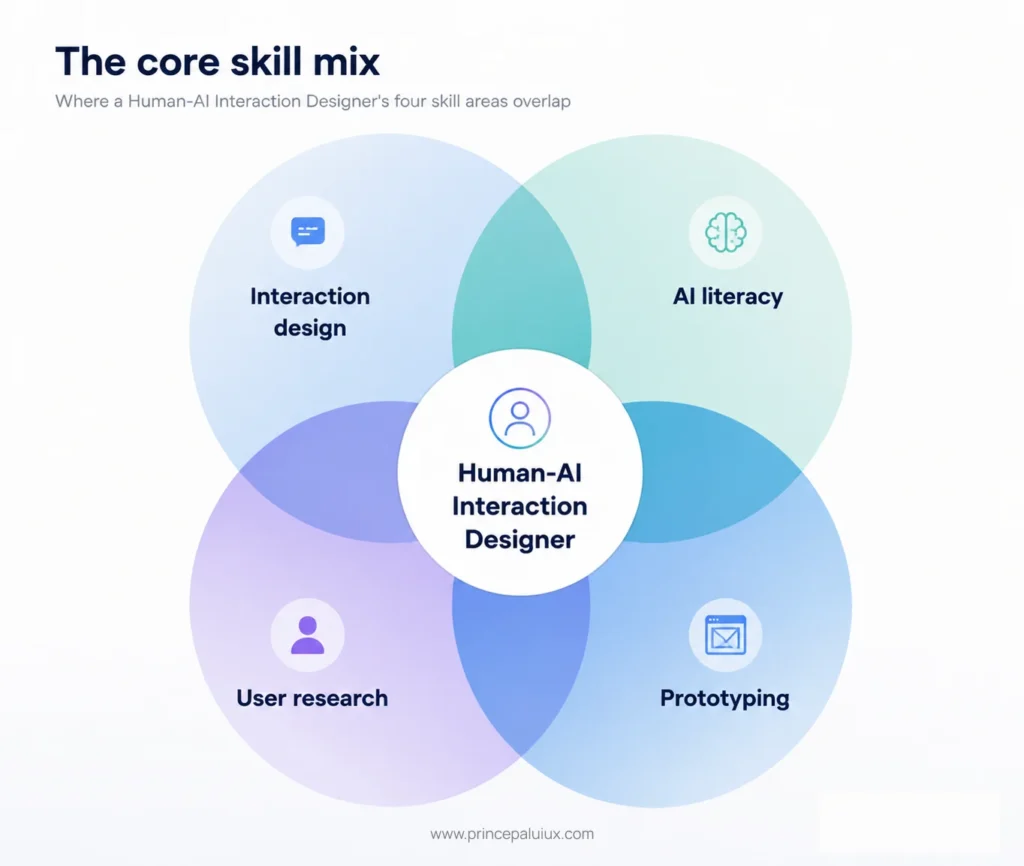
Enough technical literacy to say “no.” The best Human-AI Interaction Designers aren’t engineers, and they don’t need to be. But they need to understand model confidence scores, know the rough difference between a recommendation engine and a generative model, and be able to push back when engineering proposes something that’s technically clever but a nightmare for users to actually trust.
A real feel for user psychology. This is the part that’s genuinely hard to teach. Predicting how a person reacts when a machine tells them something personal — “we noticed you’ve been spending more on takeout” — takes empathy, not just research skills. Get it wrong, and the product feels invasive. Get it right and users barely notice the AI at all, which, weirdly, is usually the goal.
Prototyping skills, specifically for non-linear flows. Figma is still the tool of choice here, but AI interfaces don’t follow the neat linear paths a login flow does. A good designer can map branching, probabilistic journeys — this happened, so that shows up, unless confidence was low, in which case something else happens — without the whole thing turning into spaghetti.
Essential Skills to Master
Moving into this role takes a real mix — part technical literacy, part cognitive psychology. Here’s what actually matters:
- Mental modeling: Figuring out what users think the AI is doing, even when that’s wrong, so you can close the gap before it turns into frustration.
- Data literacy: A working grasp of machine learning basics — confidence scores, what training data can and can’t cover, where a model’s guesses tend to fall apart.
- Prototyping for ambiguity: Designing flows that branch and shift instead of running in a straight line, since AI interfaces rarely behave like a simple A-to-B journey.
- Conversation design: Writing prompts, responses, and fallback messages that sound human when things go right — and stay clear and honest when they don’t.
Product/UX/UI Designer vs. Human-AI Interaction Designer
| Product/UX/UI Designer | Human-AI Interaction Designer | |
|---|---|---|
| Core focus | How a user navigates a fixed set of screens and flows | How a user relates to a system that’s guessing, predicting, or deciding |
| Design output | Wireframes, static layouts, clear linear journeys | Branching flows that shift based on confidence scores and model behavior |
| Main design question | “Does this make sense to click?” | “Does the user trust this, and can they recover if it’s wrong?” |
| Handling errors | Error states are edge cases, planned but rare | Errors and uncertainty are the default — designed from day one |
| Feedback loops | Usability testing, A/B tests on layout and copy | Ongoing feedback loops that help the AI model improve over time |
| Explaining the system | Tooltips, onboarding flows | Layered transparency — general, feature-level, and decision-level explanations |
| Required literacy | Visual hierarchy, interaction patterns, accessibility | All of that, plus ML basics, confidence thresholds, and data limitations |
| Tools | Figma, Sketch, prototyping tools | Same tools, applied to non-linear, probabilistic flows instead of fixed ones |
| Success looks like | A clean, intuitive interface | A system people trust enough to rely on, even when it’s occasionally wrong |
Real-World Examples Worth Studying
A handful of products get this balance right — folding real AI logic into interfaces that still feel simple to use.
| Product | Focus Area | Why It Works |
|---|---|---|
| Spotify AI DJ | Personalization | Pairs listening data with a voice that actually explains why it picked a certain genre mix, instead of just playing tracks silently. |
| Adobe Firefly | Co-creation | Lets artists steer generative output with structured prompts and negative keywords, so the control feels precise instead of hit-or-miss. |
| Grammarly | Confidence & control | Uses color-coded suggestions that explain the grammar rule behind each one before you ever hit “accept.” |
| Google Maps | Uncertainty | Shows “eco-friendly” route options with clear percentage numbers on fuel savings versus time, instead of a vague green badge. |
Why This Role Even Exists Now
You might be wondering why this wasn’t a job five years ago. Simple answer: AI wasn’t sitting inside consumer products at this scale. Now it’s in banking apps flagging fraud, health apps interpreting your labs, and hiring platforms ranking candidates.
When a system makes a judgment call instead of just displaying information, the stakes for good design go way up — a confusing dropdown menu annoys someone; a confusing AI decision can make someone lose trust in your product entirely, or worse, make a bad call based on it.
Job postings reflect this shift. Big consulting firms are now hiring specifically for “Human-AI Interaction Designer” roles on finance transformation teams, translating agentic AI capabilities into interfaces people can actually trust.
Healthcare, fintech, and enterprise software companies are doing the same. Pay varies a lot depending on seniority and location, but experienced designers in this space are commanding rates well above general UX roles — some postings list total compensation north of $200,000 for senior positions at large firms.
That’s not hype. It reflects how specialized the skill set has become.
How to Hire One (Without Getting Fooled)
Alright, here’s the part you probably came for. Hiring for this role is trickier than hiring a regular product designer, mostly because half the industry is slapping “AI” onto job titles without changing what the person actually does. A few things worth checking before you sign a contract or make an offer:
Ask them to walk through a failure case, not a success case
Anyone can show you a polished AI feature that worked perfectly in a portfolio review. Ask instead: “Tell me about a time the AI got it wrong in front of a user. What did you design for that moment?” The answer tells you everything about whether they think in terms of trust and recovery, or just in terms of pretty outputs.
Check for genuine framework knowledge, not name-dropping
It’s easy to mention “Microsoft’s HAX guidelines” in an interview. It’s harder to explain which of those guidelines you’d apply to, say, a medical diagnosis tool versus a music recommendation app, and why the two cases call for different amounts of explanation. Push a little on the “why,” not just the “what.”
Look for someone who asks about the model, not just the interface
A designer who never asks “how confident is this model, typically, and what happens at the edges?” is still designing static screens — just with an AI label stuck on top. The good ones want to know where the system is shaky before they design a single screen.
Don’t skip the writing sample
So much of this job comes down to how an AI communicates uncertainty, errors, and limitations in plain language. A designer who can’t write a clear, honest “we’re not totally sure about this” message is going to struggle with the core of the job, no matter how clean their Figma files look.
Consider fractional or contract-based hiring first
Because this is still a maturing specialty, a lot of companies are testing the waters with fractional Human-AI Interaction Designers before committing to a full-time hire — bringing someone in for a defined engagement to audit an existing AI feature, build out the feedback and transparency patterns, and hand off a system the internal team can maintain.
It’s a lower-risk way to get senior-level thinking on a genuinely new kind of design problem, without betting a full headcount on a title that’s still settling into what it means.
Core Skill Sets
- Behavioral psychology & UX: A solid handle on cognitive load, user intent, and what actually builds trust between a person and a system that isn’t human.
- AI literacy: Working knowledge of large language models, machine learning basics, NLP, and computer vision — enough to spot what’s technically realistic.
- Cross-disciplinary collaboration: Fluency in translating between engineers, data scientists, and end users, so the finished product speaks plain human instead of model output.
Human-AI Interaction Design Principles
Designing AI experiences isn’t just about making the technology work. People need to understand what the AI is doing, feel confident using it, and know they can step in when something goes wrong.
Core Design Principles
- Transparency: Explain what the AI is doing and why, using language people can understand.
- User Control: Give people the ability to guide, correct, edit, pause, or override AI actions when needed.
- Predictability: Keep AI behavior clear and consistent so users know what to expect.
- Graceful Failure: AI will make mistakes. Give users clear explanations and practical ways to recover when it does.
- Continuous Learning: Use user feedback to improve the experience and help the AI become more useful over time.
Trust and Transparency
Trust grows when people can see how AI fits into the experience.
- Explain AI decisions in simple, human language.
- Show confidence or uncertainty when it matters.
- Make it clear when AI is making a recommendation, generating content, or taking an action.
- Design for users with different levels of AI knowledge.
- Give people simple ways to provide feedback and correct AI output.
Ethical Considerations
Good AI UX also needs to think beyond the interface.
- Watch for bias and unfair outcomes.
- Protect personal information and give users control over their data.
- Create inclusive experiences that work for people with different needs and abilities.
- Think about how AI design decisions may affect people beyond the product.
- Build responsible AI practices into the design and development process.
The Bigger Picture
Every wave of new technology has created a design specialty nobody saw coming. Mobile created interaction designers who thought in gestures instead of clicks.
The web created information architects. AI is doing the same thing again — creating a role focused less on how things look, and more on how much a person can reasonably trust a system that’s guessing, learning, and occasionally wrong.
If you’re building anything with AI in it right now, this isn’t a nice-to-have. It’s becoming the difference between a product people actually rely on and one they quietly stop using the first time it gets something wrong. Worth hiring for. Worth hiring well.
FAQs
1. What’s the difference between a UX designer and a Human-AI Interaction Designer?
A regular UX designer maps out what happens when someone clicks a button. A Human-AI Interaction Designer maps out what happens when a model makes a guess — how confident it sounds, what happens when it’s wrong, and how a person can correct it.
2. Do I need a Human-AI Interaction Designer if my product only uses AI in one small feature?
Probably, yes — at least for that feature. Even a single AI-powered recommendation or alert needs someone thinking through trust, transparency, and what happens when it misses. The scope can be small; the thinking still matters.
3. What tools do Human-AI Interaction Designers actually use?
Figma is still the main one, especially for mapping non-linear, branching flows. Beyond that, they lean on frameworks rather than software — Microsoft’s HAX Toolkit and Google’s People + AI Guidebook are the two most commonly referenced.
4. Is this the same thing as a conversational AI or chatbot designer?
It overlaps, but it’s broader. Conversational design is one piece of the job — scripting how an AI listens and responds. A Human-AI Interaction Designer also handles things that have nothing to do with chat, like explainability, feedback loops, and graceful failure.
5. How much does it cost to hire one?
It ranges a lot. General interaction designer salaries sit somewhere between $70K and $110K, but senior Human-AI specialists at larger companies have been posted well above $200K in total compensation. Fractional or contract engagements are usually the more affordable entry point.
6. What background should I look for when hiring?
A mix, not a single path. Some come from traditional UX, some from HCI research, some from conversational design. What matters more than the résumé is whether they ask about the model’s confidence and failure modes before they design a single screen.
Want these dropped into a standalone file, or is inline good since they’ll likely sit under the article on the page?